Donon Temple, Archaeological site on Mont Donon, France
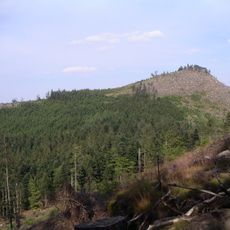
Donon Temple is an archaeological site on a mountain in the Vosges that now displays a reconstructed building with four pillars and a stone roof. The site sits at about 1000 meters elevation and holds ancient objects and inscriptions from Celtic and Roman times.
An ancient sanctuary with Celtic and Roman origins was discovered on this mountaintop during 19th-century archaeological work. The temple structure seen today was built in 1869 to display and protect the artifacts found there.
The summit was a pilgrimage site dedicated to Mercury from the 1st to the 3rd century, where steles, votive offerings and statues were found. The name Donon is still used for the mountain and the temple-museum that became its emblem. The 1869 building, erected in a primitive Greek style, is now classified as a monument historique.
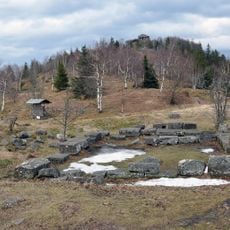
The temple-museum and the Gallo-Roman remains stand on the summit plateau of the Donon, in the commune of Grandfontaine, northwest of Schirmeck. The summit and the sanctuary vestiges have been classified as monuments historiques since 26 June 1934. The stone blocks of the base are roughly hewn with uneven edges, so watch your footing on the plateau.
The 1869 building was designed by architect Louis-Michel Boltz in a primitive Greek style, with four square-section monolith pillars on two bays of depth carrying a heavy roof of stone slabs. Built of pink sandstone without mortar, it has no real relation to the Gallo-Roman remains beside it, yet became the emblem of the summit. It was classified as a monument historique on 6 December 1898.
The community of curious travelers
AroundUs brings together thousands of curated places, local tips, and hidden gems, enriched daily by 93,210 contributors worldwide.