Château de Dieppe, Medieval castle and art museum in Dieppe, France.
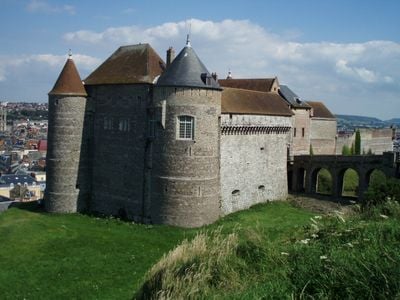
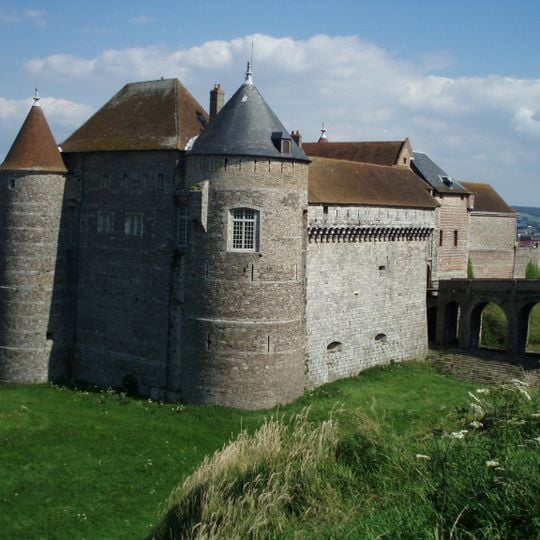
The Château de Dieppe is a quadrangular fortress with round corner towers, built of flint and sandstone, standing on a terrace about 30 metres above the sea on the Caude-Côte cliff. Its oldest surviving element is the west tower, 11 metres in diameter with walls 2 metres thick. The complex includes a lower court, a brick bastion and a long polygonal rampart added in the 18th century. Since 1923 it has housed the municipal museum.
Henry II of England founded the castle in 1188, and Philip II of France destroyed it in 1195. The west tower, 11 metres across with walls 2 metres thick, dates from around 1360, when Dieppe's town walls were built. Charles des Marets rebuilt the fortress after 1435, and it withstood the Burgundians in 1472.
Since 1923 the castle has housed Dieppe's municipal museum. Its ivory collection, begun with pieces given by local families, includes crucifixes, rosaries, statuettes, fans and snuffboxes carved in Dieppe workshops. The museum also keeps maritime exhibits and the papers and belongings of composer Camille Saint-Saëns, born in Paris but long tied to the town.
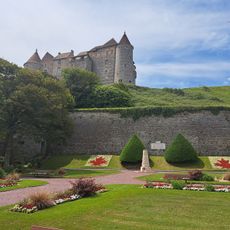
The castle stands on a terrace about 30 metres above sea level on the Caude-Côte cliff flank, overlooking Dieppe to the east. Access is on foot from the town below; the grounds and the museum rooms are reached within the former quadrangular enclosure. The west tower, the oldest surviving element, has walls 2 metres thick and arrow slits still visible.
During heavy bombardments in the late 17th century, the town around it suffered major destruction, yet the fortress itself kept its basic structure. This resilience makes it one of the few buildings that survived that turbulent period.
The community of curious travelers
AroundUs brings together thousands of curated places, local tips, and hidden gems, enriched daily by 93,136 contributors worldwide.