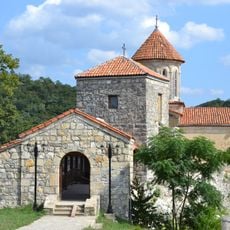
Gelati Monastery, Medieval monastery in Kutaisi, Georgia.
Gelati Monastery is a medieval monastery in Kutaisi, Georgia, with several connected churches and chapels arranged around a central courtyard. The interior walls and vaulted ceilings feature detailed frescoes depicting biblical scenes and saints throughout the complex.
King David IV of Georgia founded the monastery in 1106 as a center for education and religious studies. The site was expanded over time and became one of the most important institutions in medieval Georgia.
The name Gelati may derive from Genath, a gate of Jerusalem. The monastery was called "a new Hellas" and "a second Athos" for its scholars, among them Ioane Petritsi, who wrote commentaries on Proclus, and Arsen Ikaltoeli, author of the Dogmatikon. The Khakhuli triptych was kept here from the 12th century until its theft in 1859; returned in 1923, it was reduced in condition.
The monastery stands on a hill 11 km northeast of Kutaisi, above the Tskaltsitela gorge, and is reached by road. The main entrance is on the south side of the enclosing wall, where the tomb of David IV lies. Paths and stairs cross uneven stone, so sturdy shoes help.
Near David IV's tomb at the main entrance stand the Ancient Gates of Ganja, taken by King Demetrius I in 1138. The monastery also housed the Khakhuli triptych from the 12th century until its theft in 1859; it was returned in 1923 in reduced condition.
The community of curious travelers
AroundUs brings together thousands of curated places, local tips, and hidden gems, enriched daily by 94,356 contributors worldwide.