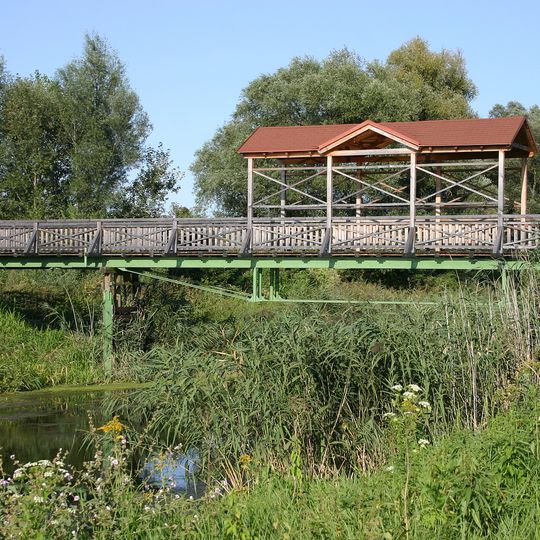
Brücke von Andau, Border footbridge between Andau, Austria and Kapuvár, Hungary
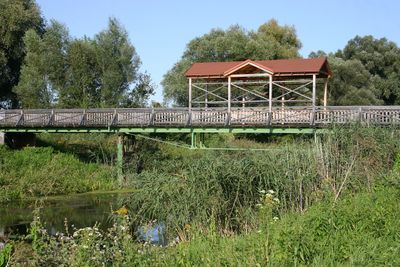
The Brücke von Andau is a small wooden footbridge over the Einserkanal, the artificial canal forming the Austrian-Hungarian border near Andau. It has a straight deck with weathered wooden railings divided into rectangular panels with diagonal cross-bracing. A small wooden pavilion with a shallow pitched roof of reddish-brown tiles stands at its centre.
After the Hungarian uprising in 1956, the original bridge and surrounding area served as an escape route for around 70,000 people until Soviet forces destroyed it in November that year. The current bridge was rebuilt in 1996 as a memorial to those events.
The nine-kilometre path from the bridge to Andau is called the Fluchtstraße, the Road of Freedom. Since 1996 it has held an open-air exhibition titled "Road of Woes", with about ninety sculptures and installations by Hungarian and Austrian artists. The bridge itself appears in James Michener's 1957 book The Bridge at Andau and in the 2000 film Der Bockerer III.
The bridge crosses the Einserkanal at right angles, running roughly north towards Austria at an azimuth of 56 degrees. On the Hungarian side a corridor south of the bridge is open to pedestrians and cyclists from April to October. The nine-kilometre Fluchtstraße links the bridge to Andau.
The 1957 book 'The Bridge at Andau' by James Michener told the personal stories of people who escaped across this bridge, shaping how the western world understood the escape. The work remains today an important account of these historical moments.
The community of curious travelers
AroundUs brings together thousands of curated places, local tips, and hidden gems, enriched daily by 92,643 contributors worldwide.