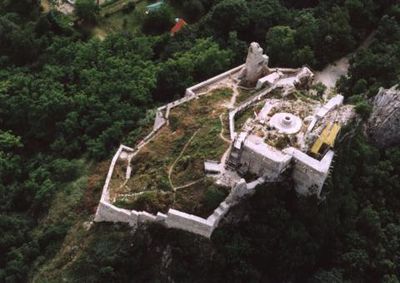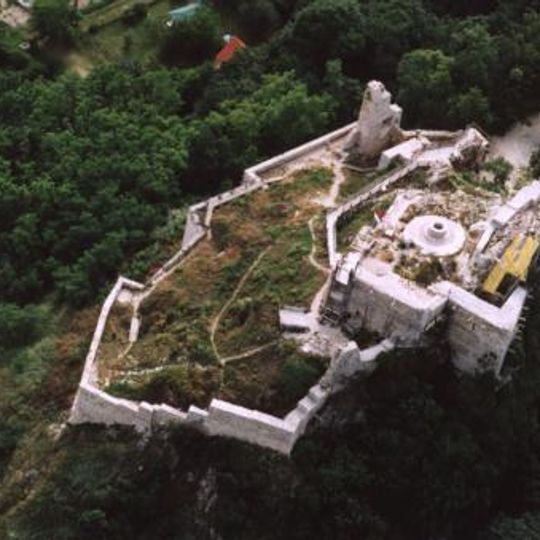
Castle of Csókakő, Medieval castle ruins in Vértes Mountains, Hungary.
Castle of Csókakő is a fortress ruin in the Vértes Mountains perched on a limestone cliff at around 500 meters elevation. The restored white towers and walls are visible from great distances and shape the landscape.
Csókakő is first documented in 1299, when István, son of Márk, lived there with his family and servants. King Charles Robert took the castle from him in 1326, exchanging it for the dombó and nyék estates. In the 15th century the Rozgonyi family held it, and István Rozgonyi was its captain. After Székesfehérvár fell in 1543, the garrison opened the gates to Ahmed, bey of Fehérvár, without a fight in 1544; a 1552 pay list records 33 janissaries stationed here. It was freed from Ottoman rule in autumn 1687.
The castle's name, meaning "goat stone", comes from the Csóka-hegy hill on whose slope it stands. The lower castle's gate tower, built under the Rozgonyi family in the 15th century, still stands. A chapel on the terrace between the two castles preserves the pillars of its sanctuary, and a 1690 sketch shows a mosque that Evliya Çelebi also mentions.
The castle stands on a rock plateau on the side of the 479 m Csóka-hegy, with steep rock walls on three sides and an artificial rock ditch. The upper castle measures about 28 by 15 metres. The site is a ruin with uneven ground, so wear sturdy footwear. The castle was made a monument in 1953 and has been under restoration since 2017 within the National Castle Programme.
A 1690 sketch shows a mosque inside the castle, also mentioned by Ottoman traveller Evliya Çelebi, though excavations have not found its remains. The fortress was defended on three sides by steep rock walls and a artificial rock ditch.
The community of curious travelers
AroundUs brings together thousands of curated places, local tips, and hidden gems, enriched daily by 94,228 contributors worldwide.