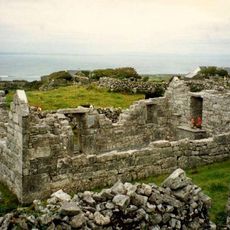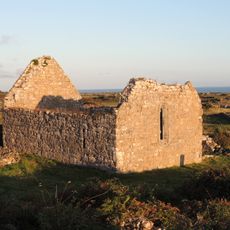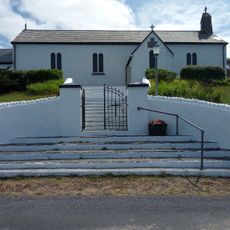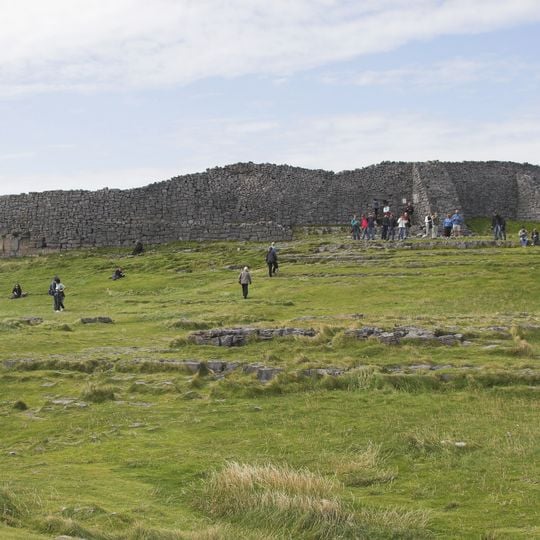
Dun Aengus, Prehistoric hill fort in County Galway, Ireland.
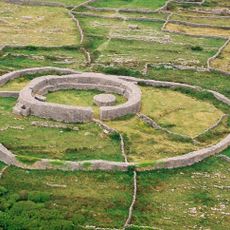
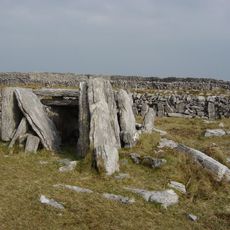
Dun Aengus is a prehistoric hill fort on Inis Mór, Inishmore, County Galway, formed by four concentric dry-stone walls of rough grey blocks, the outermost enclosing about 6 hectares. The walls stand up to 4 m wide and were rebuilt to 6 m with mortar-set wall walks, chambers and stairs. A rectangular opening framed by taller upright stones pierces the wall above a grassy slope.
Excavations show the first enclosure was built around 1100 BC, when rubble was piled against large upright stones; bronze-casting moulds dated to about 900 BC were found. Around 500 BC the triple wall defences were probably raised on the western side. An early Iron Age bird-head fibula was found in a wall in 1839, and T. F. O'Rahilly placed construction in the 2nd century BC under the Builg after the Laginian conquest of Connacht.
The name comes from a pre-Christian god, and the structure shows signs of being a place for religious gatherings. Visitors can see how carefully the stone walls were built, reflecting the importance this location held for early inhabitants.
The site is accessible via a path from the visitor center and is located on an island served by regular ferry connections from the mainland. Wear sturdy shoes and prepare for changing wind and wet conditions common to coastal exposed locations.
Between the walls lies a field of sharp stones planted vertically into the ground, which served as a defensive barrier. This unusual defense method was rarely used at other fortifications from this era and region.
The community of curious travelers
AroundUs brings together thousands of curated places, local tips, and hidden gems, enriched daily by 94,103 contributors worldwide.