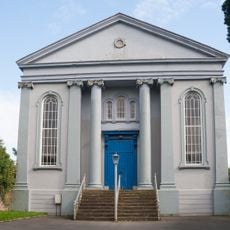
Lifford Courthouse, Neoclassical courthouse in Lifford, Ireland
Lifford Courthouse is a neoclassical building of ashlar stone, designed by Michael Priestley and completed in 1746. Its asymmetrical front of eight bays faces The Diamond, with a central doorway in a banded stone surround and a pediment; a stone panel above shows the coat of arms of George II.
Lifford Courthouse was completed in 1746 to a neoclassical design by Michael Priestley, built in ashlar stone. Its basement held a prison until a purpose-built jail opened next to it in 1793. The Grand Jury Room became the meeting place of Donegal County Council after the Local Government (Ireland) Act 1898; the council moved to County House in 1930. The building served as a courthouse until 1938 and reopened as a heritage centre in 1994.
The building serves as a visitor center where actors portray historical prisoners during guided tours through the former cells and chambers. These performances bring to life the stories of those once held within.
The building is open to the public as a museum and visitor centre, with guided tours that begin with visitors being 'arrested' and led down into the cells. The Jailbreak escape rooms can be booked for a 60-minute session. The building also houses a bistro, a library and conference rooms.
Among the prisoners held here were James Napper Tandy, a founding member of the Society of United Irishmen, and the crew of La Hoche, the French frigate on which Wolfe Tone was captured. The courthouse also witnessed the 1761 'half-hanging' of John 'Half-Hung' MacNaghten, one of its earliest recorded public hangings.
The community of curious travelers
AroundUs brings together thousands of curated places, local tips, and hidden gems, enriched daily by 94,069 contributors worldwide.