Har HaMenuchot, Jewish cemetery on Mount HaMenuchot in Jerusalem, Israel
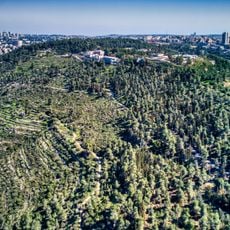
Har HaMenuchot is Jerusalem's largest cemetery, on a hilltop 750 meters above sea level at the city's western edge, next to Givat Shaul and above Highway 1. Each grave is an underground plot topped by a rectangular poured-concrete platform faced with stone tiles rising about 0.6 meters, inscribed with the name, date and praises of the deceased. Newer sections combine two-tier ground graves with multi-storey wall burial, and the 2019 underground complex adds 24,000 graves reached by three elevators.
In 1948 the Arab siege cut off the Mount of Olives, so Jerusalem opened temporary cemeteries at Sanhedria, Sheikh Badr and the old Shaare Zedek Hospital. Developers then chose a 300-dunam hilltop between Givat Shaul and Motza with soft rock for digging, and the first burials took place in 1951. Civilian graves were moved here from Sheikh Badr and Shaare Zedek, and by 2008 the cemetery covered 580 dunams with over 150,000 burials.
Burial sections are run by separate chevrei kadisha: Kehillat Yerushalayim holds over half the land, alongside Ashkenazi (Perushim), Sephardi and Hasidic societies, joined in the late 1990s by Kurdish, Georgian, Yemenite and Bukharan sections. Kehillat Yerushalayim also reserves a section for people whose Jewish identity is questioned, such as non-Jewish immigrants and atheists. Kohanim are buried in a separate area outside the main entrance so their relatives, barred from cemeteries, can pray from the road.
The cemetery lies on a hilltop at 750 meters above sea level on Jerusalem's western edge, next to Givat Shaul and above Highway 1. The underground complex opened in 2019 is reached by three elevators and has ventilation and lighting; unlike the open grounds, its gates close at night and on weekends. Priests (kohanim) are buried in a separate area outside the main entrance so their relatives can pray from the road.
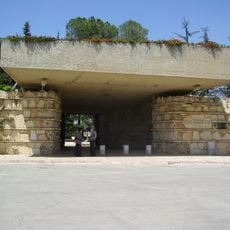
The underground complex inaugurated on 30 October 2019, called "Minharot Olam", holds 24,000 graves reached by three elevators, with ventilation, lighting and traffic-control systems; it cost about NIS 300 million. In December 2024 the tunnelling project won the International Tunnelling Association's ITA award in the "Beyond Engineering" category. Unlike the open slopes, the tunnels have gates locked at night and on weekends.
The community of curious travelers
AroundUs brings together thousands of curated places, local tips, and hidden gems, enriched daily by 93,138 contributors worldwide.