Sidna Ali Mosque, Medieval mosque at Mediterranean coast, Herzliya, Israel
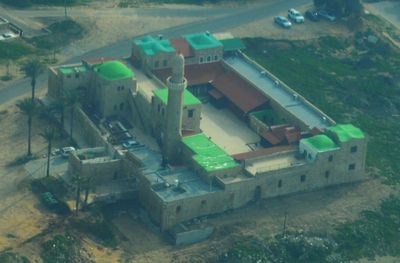
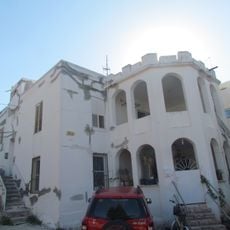
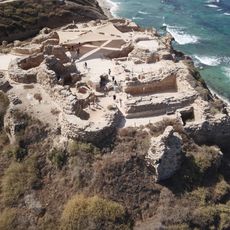
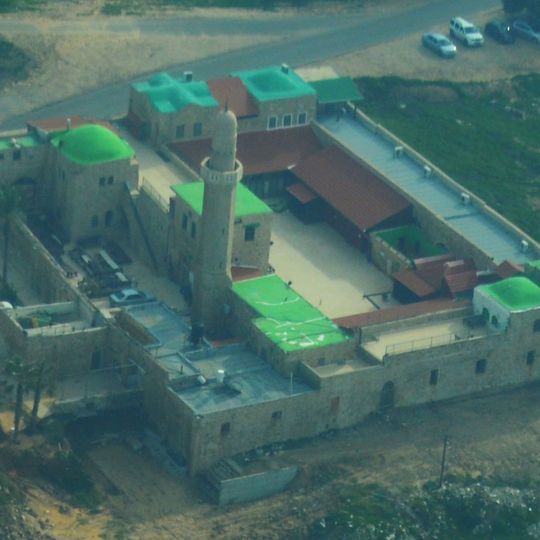
Sidna Ali Mosque is a walled stone complex of tan blocks on a cliff above the Mediterranean in Herzliya. A slender cylindrical minaret with a balcony rises near the center, above mostly flat bright-green roofs and one long pitched roof of reddish-brown tiles. The complex surrounds a light-colored courtyard, and rows of small dark arched and rectangular windows pierce the walls.
The mosque grew in stages: its vaulted arcades date between the 13th and 15th centuries, with major additions in the late 15th century, and the building was repaired in 1926, the 1950s and 1991–1992. Its minaret was destroyed by naval bombardment in World War I and later rebuilt. The tomb of Ali b. Alim, who died in 1081, is said to have been visited by Sultan Baybars in 1265 before he retook Arsuf.
The name Al-Haram, "the sacred place", was used for the village that stood here until 1948. An annual festival was held at the mosque from the 15th century until the 1940s, and since 1990 Israeli Arabs from Galilee, Jaffa and Ramla come on Fridays to pray at the tomb.
A paved pathway connects the building to the nearby parking area, making access straightforward. Visitors should know the mosque is an active place of worship where respectful clothing and behavior are expected.
The minaret was destroyed by naval bombardment in World War I and later rebuilt; the mosque underwent major repairs in 1926, the 1950s and 1991–1992. In 1970 Menachem Golan's film "The Great Escape" was shot in the compound, which stood in for a prison.
The community of curious travelers
AroundUs brings together thousands of curated places, local tips, and hidden gems, enriched daily by 92,770 contributors worldwide.