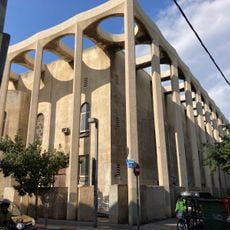
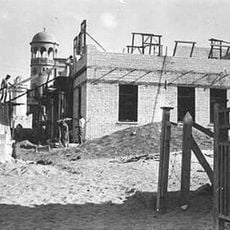
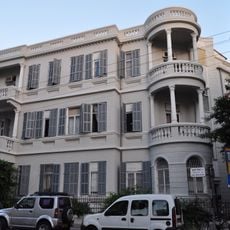
Pagoda House, Heritage residence in King Albert Square, Tel Aviv, Israel.
The Pagoda House is a three-story eclectic building at King Albert Square, on the corner of Nahmani and Montefiore Streets in Tel Aviv. Designed by architect Alexander Levy, it was built in 1924 for Maurice Bloch and has 21 arches, Doric columns, and a facade inspired by an East Asian pagoda. It combines Far Eastern, Islamic, and modern Western elements.
The house was built in 1924 by architect Alexander Levy and was among the first private buildings in Tel Aviv to include an elevator. This reflected the growing wealth and modern aspirations of the early city.
The building showcases a blend of Eastern and Western style elements that reflect the era when Tel Aviv was growing rapidly and wealthy residents commissioned houses with unconventional, cosmopolitan designs. One can see Chinese pagoda roofs alongside Islamic arches and Greek columns, showing how the city embraced different cultural influences.
The house stands at the corner of Nahmani and Montefiore Streets, facing King Albert Square in central Tel Aviv. It is a private building, so visitors see the facade and the 21 arches from the street; the restored interiors by Andrée Putman are not open to the public. The square is a short walk from nearby bus stops.
Maurice Bloch, a wealthy American widower who immigrated after World War I, commissioned the house and lived in a second-floor flat, where he hung three flags on the balcony: the American, the British and the Zionist. Ownership later passed from hand to hand, workshops moved in, and from the 1960s demolition was planned. Reuven Feld bought it in 1995 and sold it for about $5.2 million to Swedish billionaire Robert Weil before restoration began in 2000.
The community of curious travelers
AroundUs brings together thousands of curated places, local tips, and hidden gems, enriched daily by 93,684 contributors worldwide.