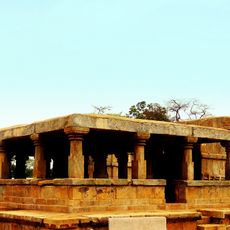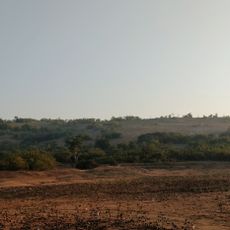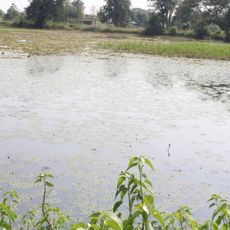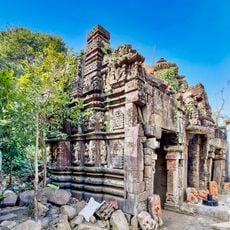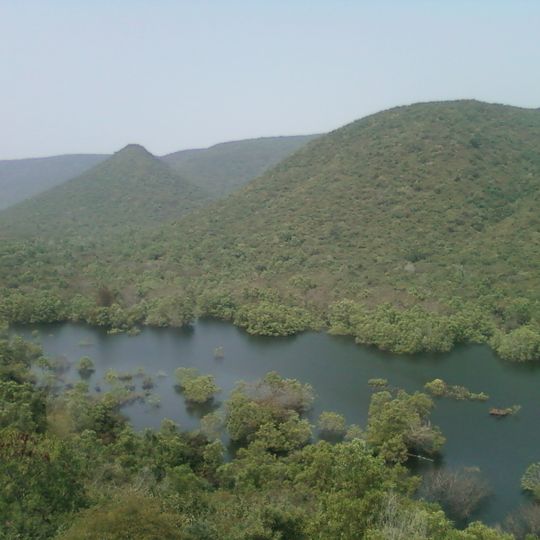
Eastern Highlands moist deciduous forests, Tropical forest ecoregion in east-central India.
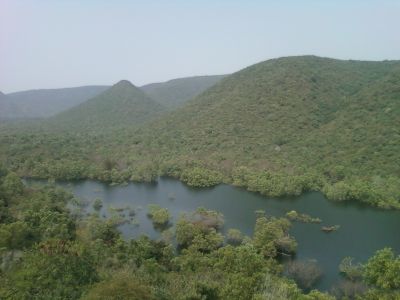
The Eastern Highlands moist deciduous forests are a woodland region spread across seven states in east-central India. The landscape includes coastal areas, rolling hills, and plateaus that transition from one terrain type to another across the region.
The ecoregion's present extent was mapped by WWF as IM0111, covering 341,100 km² across Andhra Pradesh, Chhattisgarh, Jharkhand, Madhya Pradesh, Maharashtra, Odisha and Telangana. Its forests depend on monsoon winds from the Bay of Bengal; the Eastern Ghats cast a rain shadow that encloses the drier Northern dry deciduous forests entirely within the moist zone. About 25% of the original habitat remains, and 31 protected areas covering 13,540 km² safeguard roughly 4% of the intact forest.
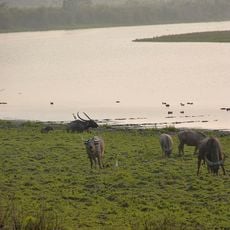
The ecoregion's name has shifted: WWF and older maps call it the Eastern Highlands moist deciduous forests, while it is now known as the East Deccan moist deciduous forests (code IM0111). The forests are dominated by sal (Shorea robusta), a tree that local communities value for timber, fuel and leaves used as plates. In Bastar district a wild population of the rare wild water buffalo (Bubalus arnee) still survives.
The ecoregion spans seven states, so pick a base near a specific reserve: Simlipal National Park in Odisha is the largest protected area at 2,550 km2, while Kawal (1,080 km2) and Indravati (1,150 km2) lie further west. Only about 4% of the intact habitat sits within the 31 protected areas, so access points are few and scattered. The forests are fed by Bay of Bengal monsoon winds, so plan around the June-to-September rains.
The ecoregion's only endemic mammal is Khajuria's leaf-nosed bat (Hipposideros durgadasi), a cave-dwelling species found nowhere else. The Bastar district also holds a wild population of the rare wild water buffalo (Bubalus arnee).
The community of curious travelers
AroundUs brings together thousands of curated places, local tips, and hidden gems, enriched daily by 93,687 contributors worldwide.