Azadi Tower, Monument in District 2, Tehran, Iran
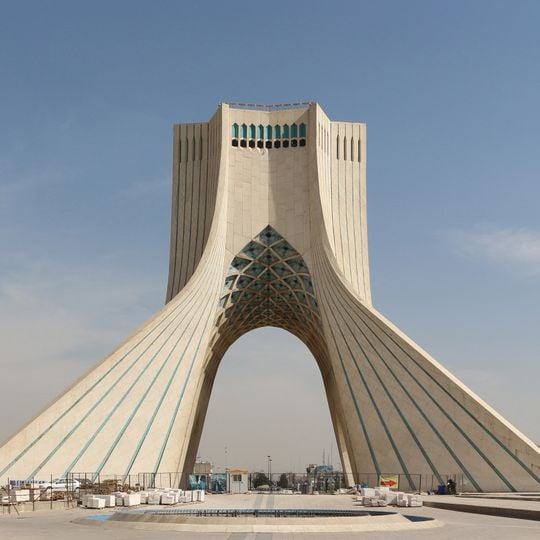
Azadi Tower is a 45-metre monument at Azadi Square in Tehran, clad entirely in white marble from Isfahan province. Its two massive legs curve inward to meet at the top, forming an open arch beneath; a pointed lattice of turquoise and dark panels fills the space above the arch. The structure rests on a paved platform with a shallow basin at its base.
Construction began in 1969 under architect Hossein Amanat and the structure opened in 1971 to celebrate the Persian Empire. The 1979 revolution led to the renaming from its original title to the current name.
The tower's name changed from Shahyad, meaning "Shah's Memorial," to Azadi, "Freedom," after the 1979 revolution. Its design draws on Achaemenid, Sasanian and Islamic architecture: the main vault echoes the Sasanian Taq Kasra, the broken arch above reflects post-Islamic forms, and the ribbed network between them represents the link between Iran's classical and post-classical eras.
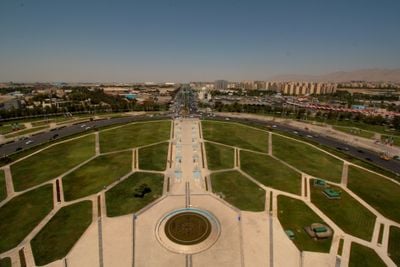
The museum occupies the basement level, reached from the paved platform beneath the arch. Inside, four floors are served by four elevators and two staircases, with 286 steps in total. The tower stands at the end of a long tree-lined avenue, with a circular fountain in front of it.
The tower is clad in white marble from Isfahan province, and the sources count 8,000 stone blocks, not 25,000 panels. The stone was located and supplied by Ghanbar Rahimi, known as Soltān-e Sang-e Irān, "Iran's Sultan of Stone". Computers were used to define the complex woven surfaces, a new technique at the time.
The community of curious travelers
AroundUs brings together thousands of curated places, local tips, and hidden gems, enriched daily by 92,688 contributors worldwide.