Snæfellsjökull, Glacier and volcano in Snæfellsbær, Iceland
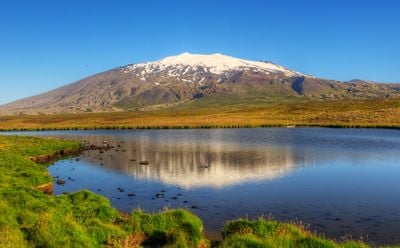
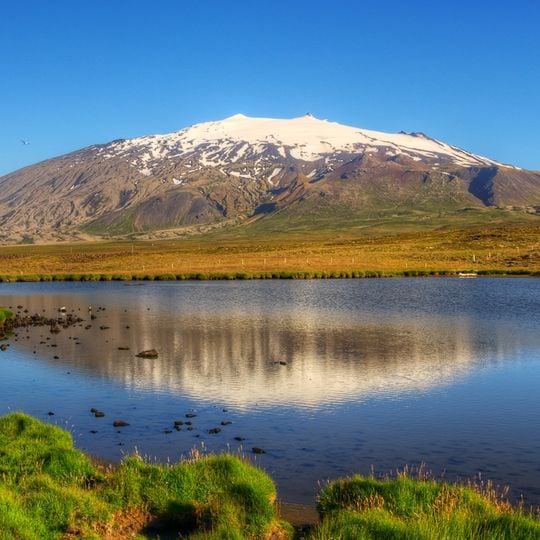
Snæfellsjökull is a glacier-covered volcano on the western tip of the Snæfellsnes peninsula in Snæfellsbær, Iceland, rising to roughly 1446 meters (about 4740 feet) above sea level. The summit bears an ice cap that changes its appearance with the seasons and can be seen from parts of Reykjavík on clear days.
The volcanic system began forming roughly 700,000 years ago through repeated eruptions during the ice age. Its last known eruption happened around the year 200, sending lava flows toward the coast and shaping parts of the present landscape.
The name means "snow-fell glacier": the mountain was originally called Snæfell or Snjófell, and jökull was added to distinguish it from two other Icelandic peaks of that name. Jules Verne made it the entry point to the subterranean journey in his 1864 novel Journey to the Center of the Earth. Halldór Laxness set his 1968 novel Under the Glacier here, and in 2024 a satirical campaign nominated the mountain for the Icelandic presidency.
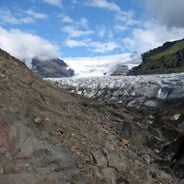
Reaching the summit requires mountaineering equipment and an experienced guide because of crevasses and rapid weather shifts. Visitors who prefer not to climb can walk trails around the base that offer views of the cone and surrounding lava fields.
On 17 July 1939, Captain Robert Bartlett of the schooner Effie M. Morrissey sighted Snæfellsjökull from 536 to 560 kilometres away, an arctic mirage that made the mountain visible far beyond the horizon. The campaign "Snæfellsjökull for President" put the mountain forward as a candidate in Iceland's 2024 presidential election, arguing it met the age and citizenship requirements.
The community of curious travelers
AroundUs brings together thousands of curated places, local tips, and hidden gems, enriched daily by 94,116 contributors worldwide.