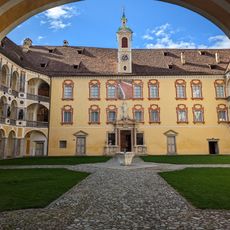
Hofburg, Episcopal palace in Brixen, Italy
Hofburg is a closed four-wing, three-storey palace begun in 1595 to plans by Alberto Lucchese for Cardinal Andreas of Austria. Its south and north wings carry open arcades over all three floors, the east wing only at ground level, and the west facade is closed around the chapel portal. The moat still holds water on the south and east sides, and the east entrance crosses a masonry bridge over it.
The palace began as a residence for Brixen's bishops, who wielded both spiritual and worldly power for centuries. In the 18th century, the building underwent major redesign that shaped its appearance as visitors see it today.
This palace served as the center where religious authority and worldly power merged for centuries, a connection still visible in how the rooms are arranged today. The collections show how the church shaped life in the region and what artistic works were created for faith.
Access to the building is straightforward since it sits in the town center and is easily reached on foot. It is wise to allow one to two hours to move through the different exhibition rooms at a comfortable pace.
The inner courtyard has open arcades on three storeys of the south and north wings, but the east wing has arcades only on the ground floor. Between the arches of the second level stand 44 terracotta statues of Habsburg family members, made by sculptor Hans Reichle around 1600.
The community of curious travelers
AroundUs brings together thousands of curated places, local tips, and hidden gems, enriched daily by 94,228 contributors worldwide.