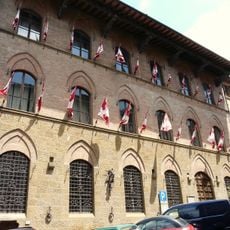
Palazzo Incontri Viti, Renaissance palace in Volterra, Italy
Palazzo Incontri Viti is a late-16th-century palace in central Volterra with a facade by Bartolomeo Ammannati, about forty metres wide and sixteen deep, with two unfinished wings. The ground floor and rear courtyard hold the Teatro Persio Flacco, inaugurated in 1828. The upper floors, bought in 1850 by alabaster merchant Benedetto Giuseppe Viti, are a house-museum with 19th-century stencil decorations and original furnishings.
Attilio Incontri, a Volterra nobleman and minister of the Grand Duke of Tuscany, began the palace at the end of the 16th century; its facade is by Bartolomeo Ammannati. In 1816 the Accademia dei Riuniti bought the ground floor and courtyard and built the Teatro Persio Flacco there. In 1850 the alabaster merchant Benedetto Giuseppe Viti bought the rest, added the second floor and its decoration, and his descendants still live here.
The palace takes its name from Giuseppe Viti, an alabaster merchant who bought it in 1850 and whose descendants still live there. The Viti workshops, leaders in alabaster working in the 18th and 19th centuries, closed in 1874. In the ballroom, two alabaster candelabra made for Habsburg archduke Maximilian I, emperor of Mexico, remained unsold after his execution in Querétaro in 1867.
The museum is typically open during warmer months and displays collections across multiple rooms and levels throughout the palace. Wearing comfortable shoes is helpful since exploring the different floors involves walking through a complex historic structure.
The theater, originally named after a Roman literary figure, occupies the lower levels of the palace and shows how private space was repurposed for public gatherings. This conversion is a rare example of how a family residence adapted to serve the community.
The community of curious travelers
AroundUs brings together thousands of curated places, local tips, and hidden gems, enriched daily by 94,563 contributors worldwide.