Sanctuary of Hera Lacinia, Ancient Greek sanctuary archaeological site in Capo Colonna, Crotone, Italy
The Sanctuary of Hera Lacinia occupies a low grassy headland at Capo Colonna, near Crotone. Its exposed remains are built of light grey and beige stone: low fragmentary wall lines, rectangular room outlines and paved floor patches, with a long straight wall running diagonally through the centre to a large rectangular enclosure. A broader paved area lies toward the right; no columns, roof or facade stand, and a metal fence borders the front edge.
The sanctuary was founded at the end of the 6th century BC and served Magna Graecia until the 4th century BC, when the Italiote League moved its federal treasury to Herakleia near Tarentum. The great Doric temple was built around 480-470 BC over an earlier archaic temple. Between the 16th and 19th centuries the ruins were quarried for the Castello di Carlo V, the city walls and the port of Crotone.
The sanctuary was named for the Lacinion promontory, which gave Hera her epithet Lacinia; the modern name Capo Colonna recalls the last column still standing, while the older name Capo Nao came from the Greek naos, temple. The site housed the federal treasury of the Italiote League until it was moved to Herakleia near Tarentum. The painter Zeuxis made paintings for the temple in the late 5th century BC, including a Helen of Troy later taken to Ambracia by Pyrrhus and then to Rome in 189 BC.
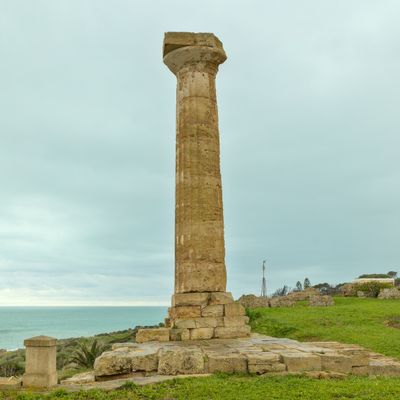
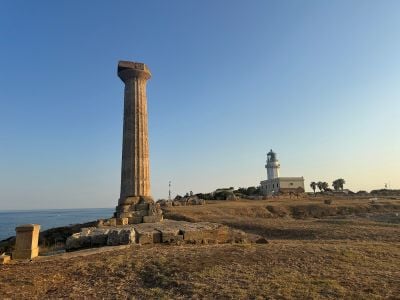
The site lies on the Capo Colonna promontory, reached from Crotone by a coastal road or from the SS 106 at Sant'Anna via the SP 50. The exposed foundations lie flat on a grassy headland behind a metal fence, with no standing roof or facade; the single Doric column stands on the stylobate remains. The Via Sacra, about 60 m long and over 8 m wide, runs beside the sanctuary area. Excavated finds, including the marble roof elements and votive offerings, are kept in Crotone.
Cicero, citing Coelius Antipater, records that the temple held a golden column. Hannibal, camped nearby for three winters before leaving Italy in 206 BC, drilled it to test whether the gold was solid and planned to take it to Carthage; warned in a dream by Juno, he instead had a small heifer cast from the drill shavings and set it on top.
The community of curious travelers
AroundUs brings together thousands of curated places, local tips, and hidden gems, enriched daily by 92,641 contributors worldwide.