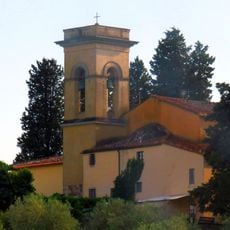
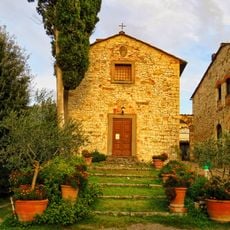
Castello di Volognano, castle in Rignano sull'Arno, Italy
Castello di Volognano is a neo-Gothic villa-farm in the hamlet of Volognano, part of Rignano sull'Arno. Its fortified origin shows in the crenellated keep, stretches of alberese stone laid in regular courses, a walled-up pointed-arch portal, and an elliptical wall with two round-arched gates. Inside the walls stand the castle, the church of San Michele, and later houses.
Roman remains were found at podere Bertinga on the western slope, and the settlement of Volognano is first named in 1214; the castle appears in a Vallombrosa Abbey act of 1220. Held by the Da Quona family, it was occupied and dismantled by the Guelf government in 1304 as reprisal, ending its defensive role. It then became a villa-farm, passing through the Del Rosso Da Volognano, Martellini della Cerva, Anforti, Della Ripa and D'Ancona families.
The name Volognano comes from the settlement, first recorded in 1214 in documents of the church of San Michele; the castle itself appears in a Vallombrosa Abbey act of 1220. Inside the walls, the church of San Michele holds works by Andrea del Sarto, Mariotto Albertinelli and Neri and Lorenzo di Bicci. The complex now runs as a neo-Gothic villa with an integrated farm.
The castle sits about 16 kilometers from Florence, making it a convenient day-trip destination from the city. The property provides parking and facilities including bathrooms, showers, and changing rooms for visitors.
The old olive oil press building has been converted into a sitting room with pull-out sofas, creating a link between the site's agricultural heritage and modern comfort. This transformation preserves evidence of how the castle once operated as a working farm.
The community of curious travelers
AroundUs brings together thousands of curated places, local tips, and hidden gems, enriched daily by 94,551 contributors worldwide.