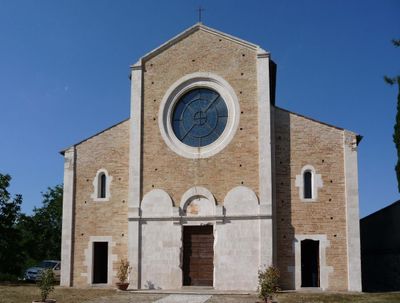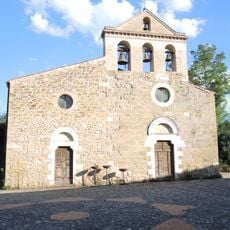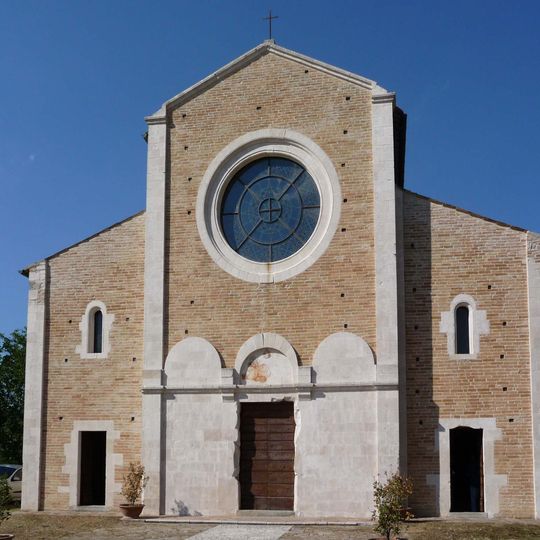
Chiesa di Santa Maria di Ronzano, Romanesque church in Castel Castagna, Italy.
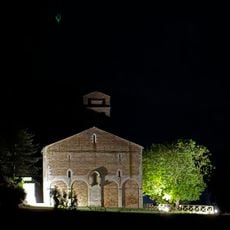
Chiesa di Santa Maria di Ronzano is a Romanesque church standing on a hillside with a brick exterior and white stone details. The interior holds three naves separated by cross-shaped pillars, with three semicircular apses at the back containing ancient frescoes.
The earliest written record is a papal rescript issued at Anagni by Lucius III on 21 January 1184, confirming a settlement of 22 December 1183 over rights to Santa Maria di Ronzano and other churches. The exact construction date is unknown; Ferdinando Bologna places it between 1170 and the early 1180s, citing an inscription read as 1171 or 1181. A 10th- or 11th-century relief of a quadruped, reused in a step near the left apse, shows an earlier structure on the site.
The apse frescoes depict Christ in a mandorla with four angels and the inscription EGO SUM LUX MUNDI, with the twelve apostles and the Annunciation below. The cycle continues with the Visitation, Nativity, Adoration of the Magi and Flight into Egypt, where Joseph wears the pointed pileus cornutus. The painted inscription at the base of the apse is read as 1181 or 1281.
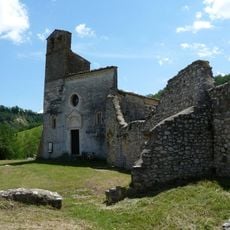
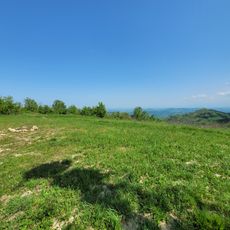
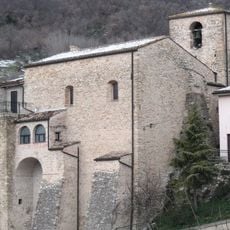
The church stands isolated on a hill above the Mavone valley at Ronzano, in the municipality of Castel Castagna. It is part of the religious tourist route called "Valle delle Abbazie". Access is via paths up the hillside; the interior has three naves and three apses, with the apse frescoes as the focal point.
A carved relief of a symbolic quadruped is set into one of the steps leading to the left apse. It is a reused piece from the 10th or 11th century, older than the church itself, and suggests earlier building work on this hilltop site before the 1183 ruling.
The community of curious travelers
AroundUs brings together thousands of curated places, local tips, and hidden gems, enriched daily by 92,884 contributors worldwide.