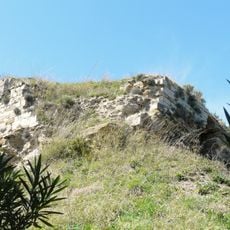
Costa Balenae, archaeological site in Riva Ligure, Italy
Costa Balenae is an archaeological area at Capo Don in Riva Ligure, on the Via Aurelia near the mouth of the Argentina stream. Excavations have revealed a partially explored Roman villa and the early Christian basilica of Capo Don, with a well-preserved octagonal baptistery, alongside a burial ground.
The site was in use from at least the 2nd century before the common era, initially as a stop on the ancient Iulia Augusta road with a wealthy villa active until the 4th century. Around the 6th century, a Christian basilica with an octagonal baptismal font was built, with its side aisles later converted into burial grounds, reflecting Christianity's growing importance in the region.
The name Costa Balenae may come from the Ligurian deity Belenus, linked to fertility and equated by the Romans with Apollo; a less documented version connects it to King Belo, father of Dido. The site is also called Area archeologica di Capo Don, after the Capo Don basilica. Edward and Margaret Berry described it in their 1931 book At the Western Gate of Italy.
The site is positioned above the Aurelia road and a coastal path, making it easily accessible from nearby roads and trails. Visitors can explore the location today through a multimedia space in Riva Ligure's town hall, as the actual ruins are not directly accessible for walking.
The octagonal baptistery of the Capo Don basilica was already brought to light in 1937 by archaeologist Nino Lamboglia. Similar in form to baptisteries in Albium Ingaunum and Forum Julii, it is described as perfectly preserved. The site is also recorded in the Tabula Peutingeriana under the name Costa Bellene, as a mansio on the Via Julia Augusta.
The community of curious travelers
AroundUs brings together thousands of curated places, local tips, and hidden gems, enriched daily by 92,765 contributors worldwide.