Fontana della Piazza dei Quiriti, Travertine fountain with caryatids in Prati district, Rome, Italy
The Fontana della Piazza dei Quiriti, also called the Fountain of the Caryatids, stands in the centre of a small green area in Piazza dei Quiriti, Prati. A circular pool slightly raised above street level holds a short baluster with relief leaves and small basins; above it a flared basin carries four seated nude female caryatids whose raised arms support a four-lobed top basin, with water jetting from a large pine cone at its centre.
The fountain was built in 1928 by sculptor Attilio Selva following a competition launched by Rome's administration to add decorative water features to newly developed neighborhoods. This period marked an expansion of public monuments in the city's modernizing districts during the early 20th century.
The four seated caryatids are nude female figures whose raised arms support the four-lobed upper basin, with water spouting from a large pine cone at its centre. Their nudity and pose caused scandal in puritan circles, and the inauguration, planned for 21 April 1928, was postponed to 9 May. The square's name refers to the Quirites, the Sabine co-founders of Rome, or to the god Quirinus.
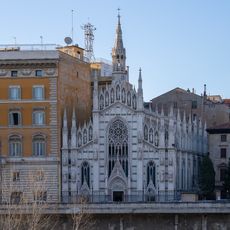
The fountain stands in the middle of a small green area at the centre of Piazza dei Quiriti, in the Prati rione, with the Church of St. Joachim, completed in 1898 by Raffaele Ingami, close to the square. The pool is slightly raised above street level with a protruding edge, so it can be seen from the surrounding pavement.
The fountain was commissioned by Rome's governor Ludovico Spada Veralli Potenziani, whom Mussolini had put in charge of the capital. The nudity and poses of the four caryatids caused such scandal that the inauguration, planned for 21 April 1928, was postponed to 9 May. The controversy is often cited among the reasons for the governor's dismissal that year.
The community of curious travelers
AroundUs brings together thousands of curated places, local tips, and hidden gems, enriched daily by 94,106 contributors worldwide.