Monzoni, Alpine subgroup in Dolomites, Italy.
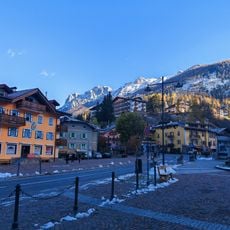
Monzoni (Munciogn in Ladin) is an arcing subgroup of the Marmolada range in the Dolomites, in Trentino. It runs from the north-west end round to the Passo delle Selle, bounded by Val di Fassa, Valle di San Pellegrino, the Auta chain and Val San Nicolò. Its highest point is Punta della Vallaccia, 2,641 m. Unlike other Fassa groups, it is built of intrusive and dyke igneous rocks such as monzonite, plus mineral-rich contact metamorphic rocks.
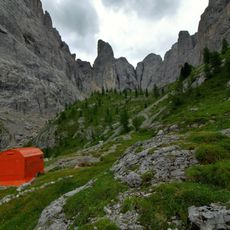
The Monzoni are named after monzonite, the intrusive igneous rock first identified here, which sets them apart from the dolomite groups around Val di Fassa. The massif's contact metamorphic rocks, rich in minerals, have drawn geological study since the 19th century. The Rifugio Monzoni Torquato Taramelli, named after the geologist Torquato Taramelli, and the nearby Rifugio Vallaccia serve as the main starting points for the massif.
The Ladin name of the group is Munciogn, and the stream that descends from it is the Ruf di Munciogn, which joins the Rio di S. Nicolò at 1,526 m. The Rifugio Monzoni Torquato Taramelli and the nearby Rifugio Vallaccia are the main starting points for the massif.
Multiple marked paths connect the surrounding valleys to the peaks, with summer being the best season for hiking. Visitors should prepare for changing weather conditions and bring sturdy footwear and navigation aids.
The Monzoni are made of intrusive igneous rocks such as monzonite, not dolomite like the neighbouring Fassa groups, and their contact metamorphic rocks are rich in minerals. The rock type monzonite is named after these mountains.
The community of curious travelers
AroundUs brings together thousands of curated places, local tips, and hidden gems, enriched daily by 92,885 contributors worldwide.