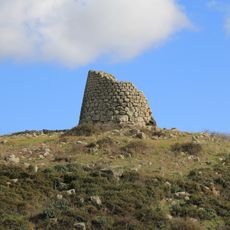
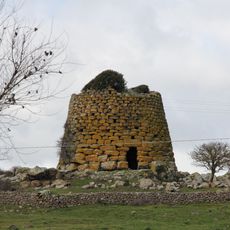
Nuraghe Orolo, Bronze Age nuraghe in Bortigali, Italy.
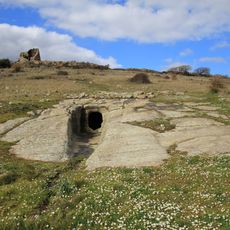
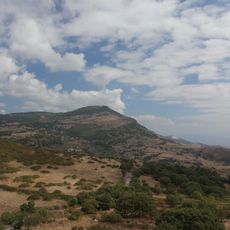
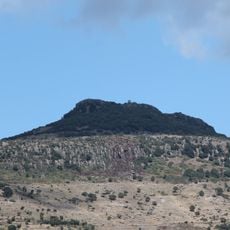
Nuraghe Orolo is a trilobate nuraghe at 785 m on the slope of Monte Cuguruttu, in Bortigali. Its main tower still stands about 13–14 m high, built of roughly squared trachyte blocks that become smaller and more regular higher up. A later two-tower bastion with a slightly concave curtain wall was added in front, and around it lie the traces of about ten circular and rectangular huts and an outer wall.
Nuraghe Orolo is a three-lobed nuraghe: a central tower with a two-tower front bastion added later. Restoration in 1998 consolidated the structure and cleared the interior; the excavation did not reach the foundation level, so no precise date was established. The few pottery fragments indicate use between the third phase of the Middle Bronze Age and the Final Bronze Age (about 1500–900 BC), with sporadic Roman presence up to about the 5th century AD.
The name Orolo belongs to a group of indigenous mountain toponyms beginning with orol-, linked to the pre-Latin root for eagle, as in the Sardinian th-orolia for kestrel or buzzard. Around the nuraghe, traces of about ten circular and rectangular huts and a forewall show where the village stood.
The site sits on a slope, so sturdy footwear and a moderate level of fitness help for exploring the complex. Allow enough time to walk through the different areas and take in the stone construction details at a relaxed pace.
The name Orolo belongs to a group of pre-Latin mountain toponyms beginning with orol-, linked by scholars to the Thracian personal name Orolos, meaning eagle; the Sardinian bird name th-orolia for kestrel or buzzard is cited as support. The site is included in a nomination of 31 Sardinian sites for UNESCO World Heritage status.
The community of curious travelers
AroundUs brings together thousands of curated places, local tips, and hidden gems, enriched daily by 93,036 contributors worldwide.