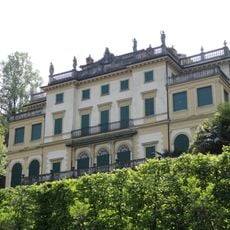
Palazzo Bolongaro, Neoclassical palace at Lake Maggiore waterfront, Stresa, Italy.
Palazzo Bolongaro is a pale yellow palace in Stresa, built from 1770 for Giacomo Filippo Bolongaro on the model of his Frankfurt residence, the Bolongaropalast. Its symmetrical facade has cream pilasters and stringcourses, a raised entrance reached by a wide stone staircase under a round-arched portico, and a small balcony with a wrought-iron railing. A rusticated stone base with arched openings and a balustrade runs along the raised ground level; the roof is dark with a slight overhang.
Giacomo Filippo Bolongaro, who left Stresa poor in 1723 for Frankfurt and made a fortune in tobacco, returned in 1770 and had this palace built on the model of his Frankfurt residence, the Bolongaropalast. After his death in 1780 his niece Anna Maria Simonetta inherited it; she left it to Antonio Rosmini in 1848, and from 1857 the Savoy royal house used it as Villa Ducale for Duchess Elisabetta of Genoa.
The palace served as a gathering place for European nobility in the 19th century and later hosted academic conferences. Its evolution from private residence to public institution reflects changing uses across different periods.
The building now houses the Centro Internazionale di Studi Rosminiani, which keeps the room where Antonio Rosmini died on 1 July 1855 and a library of about 110,000 volumes. The surrounding park covers roughly 13,000 m², with palms, osmanthus, magnolias, camellias, azaleas and rhododendrons. Access to the centre follows the institute's own arrangements.
Giacomo Filippo Bolongaro, who made his fortune in Frankfurt tobacco, had the palace modelled on his Frankfurt residence, the Bolongaropalast. The garden once reached the shore of Lake Maggiore, and Bolongaro gave a new suit of clothes to young people from Stresa leaving to look for work.
The community of curious travelers
AroundUs brings together thousands of curated places, local tips, and hidden gems, enriched daily by 92,835 contributors worldwide.