Palazzo Borghese, Neoclassical palace in Florence, Italy.
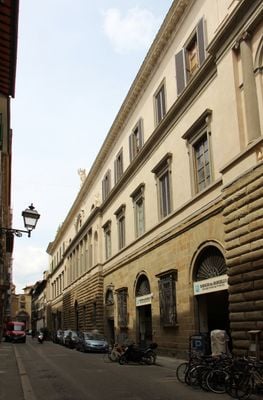
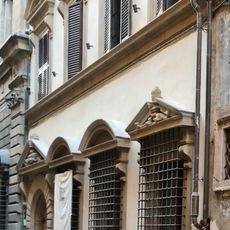
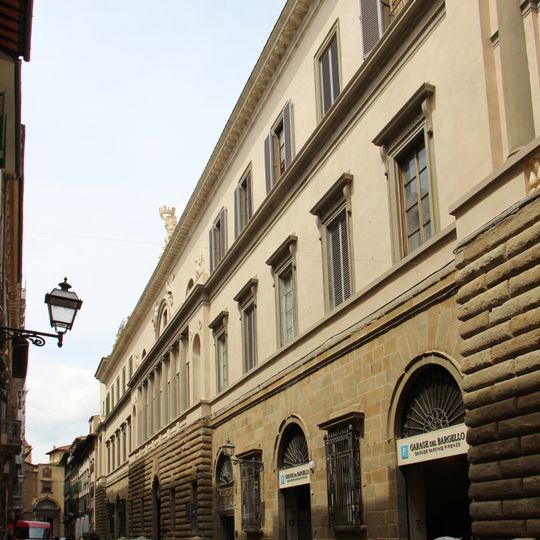
Palazzo Borghese is a neoclassical palace in Florence defined by balanced proportions and clear architectural lines. The light stone facade features large rectangular windows distributed across three stories in a harmonious arrangement.
Medieval houses of the Villani, Portinari and Covoni stood here until the Salviati bought them in the 13th century; in 1437 Alemanno and Michelozzo built a palace with a much-admired open loggia. Gherardo Silvani modernised it in 1632, adding the staircase, reception rooms and a central atrium open to both via Ghibellina and via Pandolfini. The last Salviati, Anna Maria, married Marcantonio IV Borghese; their son Camillo had Gaetano Baccani rebuild the facade in 1821-1822, inaugurated with a party on 31 January 1822.
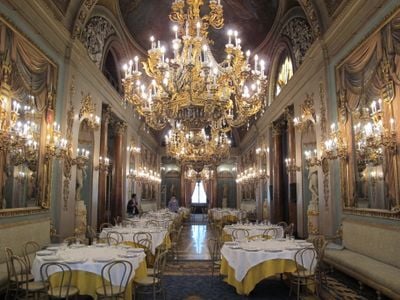
In 1709 Antonio Maria Salviati built a ballroom with an orchestra stage for his guest King Frederick IV of Denmark; it still stands aligned with the grand staircase. From 1844 the Casino Borghese, a society founded by Prince Poniatowski, rented part of the palace as a centre for cultural and social gatherings. The Tognini Bonelli family, owners since 1843, still lives in part of the building.
The building sits within walking distance of several public transportation stops, making arrival straightforward. The surrounding area is easy to navigate on foot and offers clear orientation points.
The Borghese coat of arms on the facade is flanked by two Carrara marble allegories of the Arno and the Tiber, set high as a sign. This scenic arrangement appears on only two other Florentine buildings: Palazzo Corsini al Prato and the San Firenze complex.
The community of curious travelers
AroundUs brings together thousands of curated places, local tips, and hidden gems, enriched daily by 92,892 contributors worldwide.