Palazzo Corner Mocenigo, Renaissance palace in San Polo, Venice, Italy
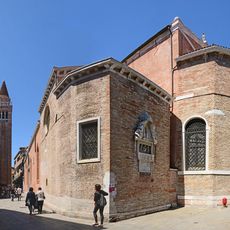
Palazzo Corner Mocenigo stands in the northwest corner of Campo San Polo, with its right side and rear facades facing the square and its main front on the Rio San Polo. It occupies an irregular lot of about 48 by 20.5 metres and rises to roughly 24 metres at the eaves, making it one of the largest palaces in Venice. The building has six storeys: three main levels (pé pian, first and second soler) with a mezzanine hidden in each of the two noble floors, plus an attic under the wide roof. The water facade is unusually tall for its narrow frontage, and the landward side on the campo is the more decorated, with overlapping triple windows, rusticated stonework and corner stones.
A 14th-century house on this site burned in 1535; Giovanni Corner then commissioned Michele Sanmicheli to rebuild it, with work starting in 1551 and finishing in 1564. The Corner family kept it until Laura Corner married Alvise Mocenigo in 1796, giving the palace its double name. The Italian state bought it on 7 December 1953 for the Guardia di Finanza.
The name Ca' Corner Mocenigo dates from 1796, when Laura Corner, last of the San Polo in Campo branch, married Alvise Mocenigo and brought the palace as her dowry. Laura was a descendant of Giorgio Corner, brother of Caterina Cornaro, queen of Cyprus and Armenia from 1474 to 1489. The building was the residence of the San Polo in Campo branch for six centuries.
The palace is not open to the public; it houses the Regional Command of the Guardia di Finanza. Its main facade faces the Rio San Polo, while the right side and rear facades look onto Campo San Polo, so the building is seen from the square or from the water. The land entrance on the square is the more decorated side, marked by triple windows and rusticated stonework.
The palace employs exceptionally thin bricks in its walls, a Roman building technique that Sanmicheli chose instead of the thicker brick methods common in Venice at that time. This engineering choice demonstrates the architect's willingness to experiment with unusual construction methods in a traditional setting.
The community of curious travelers
AroundUs brings together thousands of curated places, local tips, and hidden gems, enriched daily by 93,009 contributors worldwide.