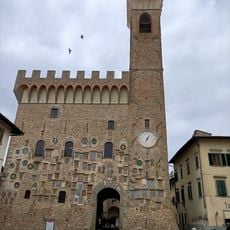
Palazzo dei Vicari, Medieval palace in Scarperia, Italy.
Palazzo dei Vicari in Scarperia began as a 14th-century tower, probably the Captain's residence, and was enlarged after 1412 when the town became a vicarial seat. The 1542 earthquake led to rebuilding that gave the palace its present form, with a crenellated tower and a wooden staircase of 102 steps to the top. Since 1999 a wing houses the Museo dei ferri taglienti, with five sections on Scarperia's knife-making.
Florence founded Scarperia in 1306 as a military outpost controlling the only road between Florence and Bologna until the mid-18th century. In 1412 the new town became a vicarial seat, prompting enlargements; in 1415 it became the seat of the Vicariato of the Florentine Republic. After the 1351 victory over Milanese troops, Scarperia received the right to Florence's lily emblem with inverted colours.
Each vicar who governed for a six-month term had to leave his family coat of arms on the facade or in the atrium. Many are glazed terracotta from Florentine workshops: those of Bernardo Lucalberti (1490) and Antonio Lorini (1491) are attributed to Benedetto Buglioni, while Santi Buglioni is credited with Francesco da Casavecchia's (1528) and Gianfranco Baroncelli's (1537).
Reaching the tower top requires climbing a wooden staircase that demands physical effort and may be challenging for those with mobility issues. The reward is a panoramic view from the defensive walkway where guards once watched for threats approaching across the landscape.
The tower's wooden staircase has 102 steps, and from the top visitors can also see the lower patrol walkway used to watch for approaching enemies. The tower clock is documented as the work of Filippo Brunelleschi, the only surviving evidence of his clockmaking, a field his biographers Manetti and Vasari say he practised widely.
The community of curious travelers
AroundUs brings together thousands of curated places, local tips, and hidden gems, enriched daily by 94,247 contributors worldwide.