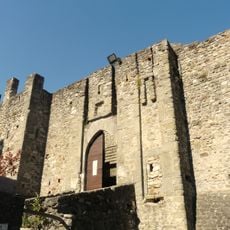
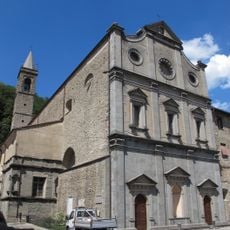
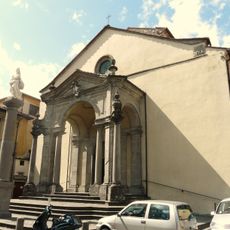
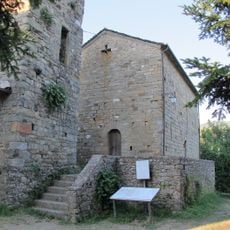
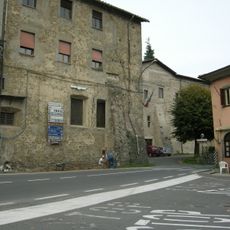
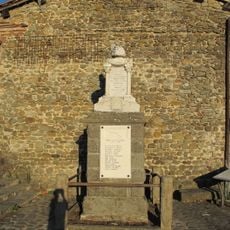
Santo Stefano, Romanesque parish church in Filattiera, Italy
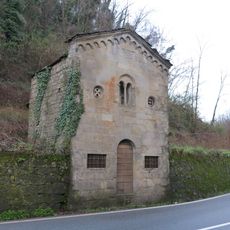
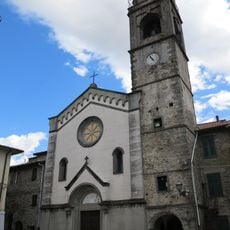
Santo Stefano is a Romanesque parish church in the Sorano locality of Filattiera, built with unsquared river pebbles set in mortar and roofed with slate slabs. Its basilical plan has three naves without a transept, a raised presbytery, and three apses framed by pilasters and arches. The facade has a four-lobed rose window, and two stele statues, Sorano I and Sorano V, are displayed inside the left counter-facade.
Santo Stefano di Sorano is cited at the end of the 10th century by Sigeric, Archbishop of Canterbury, passing through on his return from Rome along the Via Francigena. The Romanesque pieve was built between the 11th and 12th centuries during the reorganisation of the Diocese of Luni, and was confirmed among the pievi by Pope Eugene III to the bishop of Luni in 1148. It flourished until the 14th century, then was gradually abandoned and turned into a cemetery chapel.
The name Santo Stefano di Sorano appears in Sigeric of Canterbury's late-10th-century travel account, and the church was confirmed to the bishop of Luni by Pope Eugene III in 1148. Inside, the left counter-facade displays the stele statues Sorano I and Sorano V, found in the church area.
The church sits at Piazza Don Renzo Gori in central Filattiera and belongs to the Roman Catholic Diocese of Massa Carrara-Pontremoli. It is easily reached on foot in the town center.
Two statue-steles, Sorano I and Sorano V, are displayed inside the left counter-facade, recently found in the church area. The 2000 restoration also uncovered foundations from earlier periods and well-preserved tombs; one is thought to be that of Leodegar, the first bishop who came to the Lunigiana valley and destroyed pagan statues.
The community of curious travelers
AroundUs brings together thousands of curated places, local tips, and hidden gems, enriched daily by 94,532 contributors worldwide.