Teatro Coccia, Opera house in Novara, Italy
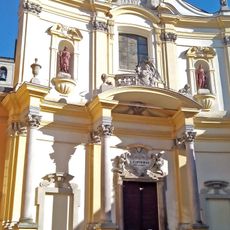
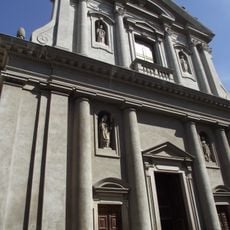
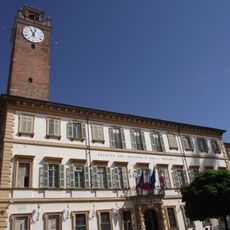
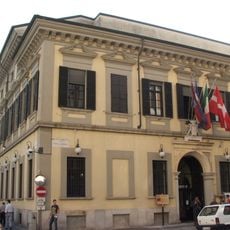
Teatro Coccia is an opera house in Novara with a pale yellow upper facade and a grey stone lower level, fronted by a portico of tall grey stone columns. Its horseshoe-shaped hall is surrounded by three orders of boxes, a first gallery and a loggione, decorated in Renaissance style with Corinthian cast-iron columns topped by a swan sculpture. The proscenium is 14 metres wide and the stage 23 metres deep.
Novara's Teatro Nuovo, designed by Cosimo Morelli, opened in 1779 with Giuseppe Sarti's Medonte re d'Epiro; the Galliari brothers painted its curtain with Hercules, the city's mythical founder. Renamed Teatro Coccia in 1873 after the composer Carlo Coccia, it was demolished in 1886 and rebuilt by Giuseppe Oliverio on a larger site. The new house opened on 22 December 1888 with Meyerbeer's Les Huguenots, conducted by Arturo Toscanini.
The theatre is named after Carlo Coccia, a Novara-born composer who led the Duomo's chapel choir for over thirty years; it took his name on 6 July 1873, months after his death. A 1932 Corriere della Sera article called it the antechamber to La Scala, since singers such as Carmen Melis and Gilda Dalla Rizza made early appearances on its stage.
The entrance portico of pink Baveno granite columns opens onto via Fratelli Rosselli, with piazza dei Martiri to the west and piazza Giacomo Puccini to the east. Inside, three tiers of boxes, the first gallery and the loggione are reached by stairs, so seats in the 918-place hall differ greatly in access. The Piccolo Coccia hall seats 200.
The 1888 inaugural performance of Meyerbeer's Les Huguenots, conducted by Arturo Toscanini, was reportedly poorly received, likely because of the score's complexity. Toscanini also led Verdi's Aida and La forza del destino there in the same opening season.
The community of curious travelers
AroundUs brings together thousands of curated places, local tips, and hidden gems, enriched daily by 94,322 contributors worldwide.