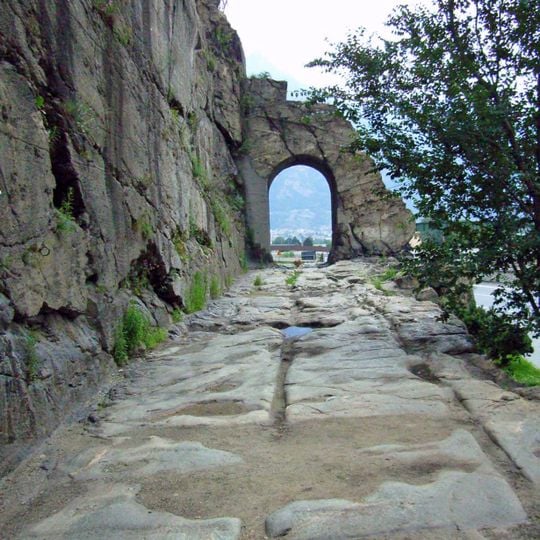
Gauls consular road, Roman road in Donnas, Italy
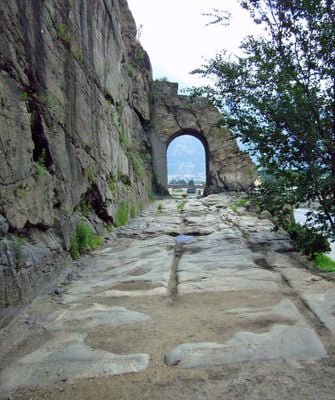
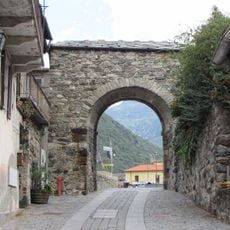
The Gauls consular road is an ancient Roman road in Donnas, a village in the Aosta Valley, Italy, where a surviving section was carved directly out of solid rock. A stone arch marks the passage through the rock face, and the road surface still shows the original paving alongside the cuts made to widen the route.
Augustus had the road built on earlier paths to link Mediolanum (Milan) with Gaul, and it was the first public work the Romans carried out in the Aosta Valley. At Augusta Praetoria (Aosta) it split, one branch heading for the Little St. Bernard Pass and Lugdunum (Lyon), the other for the Great St. Bernard Pass and Octodurus (Martigny). Milestones from the reign of Claudius (41–54) are associated with the Great St. Bernard route.
The road's name survives in local place names that record distances in Roman miles from Aosta: Quart, Nus, Diémoz and Quisnet. The route was later followed by the Via Francigena, the medieval pilgrimage road to Rome, and today long stretches coincide with the SS26 and SS27 state roads.
The site is easy to reach on foot and can be explored without a guide, though sturdy shoes are a good idea given the rough, uneven rock surface underfoot. Visiting in the morning tends to give the best light for seeing the detail of the carved rock and the arch.
The road's Roman name was via Publica or strata Publica. Near Donnas, the nineteenth-century scholar Pierre-Louis Vescoz identified remains of a pre-Roman route between Pont-Saint-Martin and Donnas, called chemin des Salasses, of which short stretches are still visible. The paved road here measures about 2.30 metres wide, cut partly into the rock and partly laid on paving.
The community of curious travelers
AroundUs brings together thousands of curated places, local tips, and hidden gems, enriched daily by 94,502 contributors worldwide.