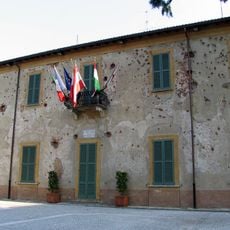
Villa Gaia, villa in Robecco sul Naviglio, Italy
Villa Gaia is a large historic residence beside the Naviglio Grande in Robecco sul Naviglio, built in the 1400s and 1500s with a mix of Renaissance and baroque features. The complex includes a main building with three connected courtyards, brick and stone walls, wooden ceilings with painted decorations, and a large garden with ancient trees and sculptures.
Villa Gaia rose from a mid-15th-century vineyard bought by Count Vitaliano I Borromeo, on the remains of a medieval fortification beside the Naviglio Grande. By October 1481 the villa hosted Duchess Bona of Savoy, widow of Galeazzo Maria Sforza, for several days. A 1493 will passed it to Ludovico Visconti on condition he take the Borromeo name. Count Eugenio Confalonieri died there on 29 November 1771; the Gandini family owns it today.
The name Gaia was already in use by the late 1400s, when Ludovico il Moro kept the villa as a hunting residence and place of entertainment. Pointed-arch windows from that period survive beneath later wall coverings. The main courtyard is porticoed on three sides and painted with 16th-century frescoes.
The villa stands in Robecco sul Naviglio beside the Naviglio Grande, and its water front is reached by a stairway down to the landing stage, the way the owners once arrived from Milan. The main courtyard is porticoed on three sides, so the route between the wings passes under cover. The stairway inside began as a ramp for horses and was rebuilt by the Biglia family in 1760.
The villa was likely one of the first residences ever built along the Naviglio Grande and served as a model for many other estates in the region. It also appeared in a famous Italian film from the 1970s, which shows how the place captured the imagination of filmmakers and audiences alike.
The community of curious travelers
AroundUs brings together thousands of curated places, local tips, and hidden gems, enriched daily by 94,460 contributors worldwide.