Rock Engraving Park of Grosio, Archaeological park in Valtellina, Italy
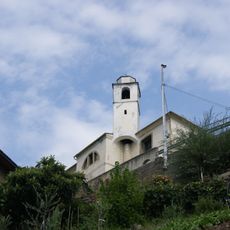
The Rock Engraving Park of Grosio covers the Dosso dei Castelli, a hill above Grosio and Grosotto in Valtellina. Its centrepiece is the Rupe Magna, an 84-metre-long, 35-metre-high rock of dark grey phyllite bearing over 5,000 engravings. Two castles stand on the hilltop: the Castello Vecchio and the 14th-century Castello Nuovo, ringed by dry-stone terraces.
Davide Pace identified the rock engravings in 1966, and the park was founded in 1978 after marchesa Margherita Pallavicino Mossi Visconti-Venosta donated the land. The Rupe Magna's more than 5,000 figures were recorded in a research project between 1991 and 1995. The Castello Vecchio was first documented in 1150, while the Castello Nuovo was built between 1350 and 1375 for the Visconti and partly demolished in 1526.
The name Rupe Magna, "great rock", refers to the 84-metre-long, 35-metre-high outcrop of dark grey phyllite. Its surface carries orants with raised arms, armed men, wrestlers, animals, cup-marks, rakes and two Christian crosses. The park, run by the Consorzio turistico Media Valtellina, organises guided tours and educational activities.
The park lies on the slopes of the Dosso dei Castelli above Grosio, with the Rupe Magna, both castles and the dry-stone terraces reached on foot along uneven ground. Sturdy shoes are advisable, and the rock surface is hot and dry in summer. The park is managed by the Consorzio turistico Media Valtellina, which organises guided visits.
The terraces around the site were built with dry stone after 1200 and are still used today for growing grapes. This structure links ancient mountain traditions with modern grape cultivation in the region.
The community of curious travelers
AroundUs brings together thousands of curated places, local tips, and hidden gems, enriched daily by 95,038 contributors worldwide.