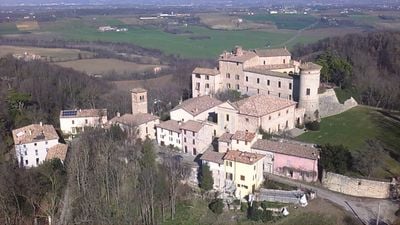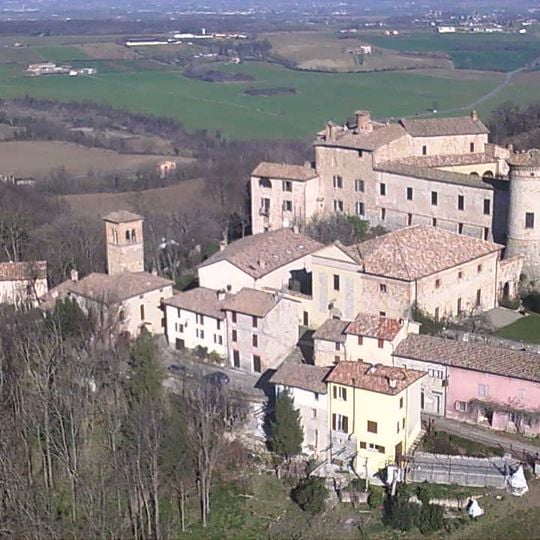
Scipione Castle, Medieval castle in Salsomaggiore Terme, Italy
Scipione Castle is a fortress on a hilltop with reinforced walls, cylindrical towers, and a historic entrance that once featured a drawbridge. The structure comprises multiple buildings around a central courtyard, with several halls containing decorative architectural elements inside.
Adalberto Pallavicino built the original castle in 1025 on the remains of a Roman villa linked by tradition to the consul Gnaeus Cornelius Scipio Calvus, from whom the site takes its name. The Pallavicino family controlled salt extraction from wells in the nearby Salsomaggiore valley, and the fortress became known as the Castello del Sale. In 1447 the brothers Lodovico and Giovanni Pallavicino rebuilt and strengthened it against firearms, raising the round tower and digging a deeper moat.
The name Scipione comes from a Roman villa said to have belonged to the consul Gnaeus Cornelius Scipio Calvus, uncle of Scipio Africanus, on whose remains the castle was built in 1025. The entrance tower bears a fresco of the crowned double-headed eagle, the Pallavicino coat of arms, between the slots that once held the drawbridge bolts. Inside, the vault is painted with the Apparition of the Virgin to Saint Carlo and Santa Maria Assunta.
The castle was partially opened to the public in 2008, and further restored rooms, including the north-west wing and the square tower, became visitable in 2012. Two suites in the watchtower and the hall next to the old entrance are let to tourists. The complex stands within the small medieval village on the hillside.
During World War II, the castle served as a detention facility for prisoners and later as a deportation processing point. This dark chapter is now an important part of its history that visitors should know about.
The community of curious travelers
AroundUs brings together thousands of curated places, local tips, and hidden gems, enriched daily by 94,036 contributors worldwide.