Iglesia de San Giovanni in Val di Lago, Ruined church in San Lorenzo Nuovo, Italy
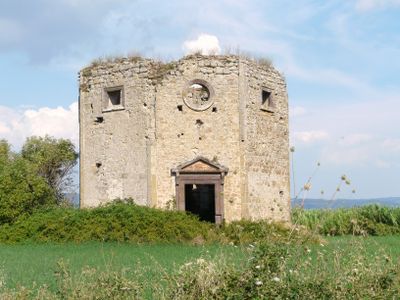
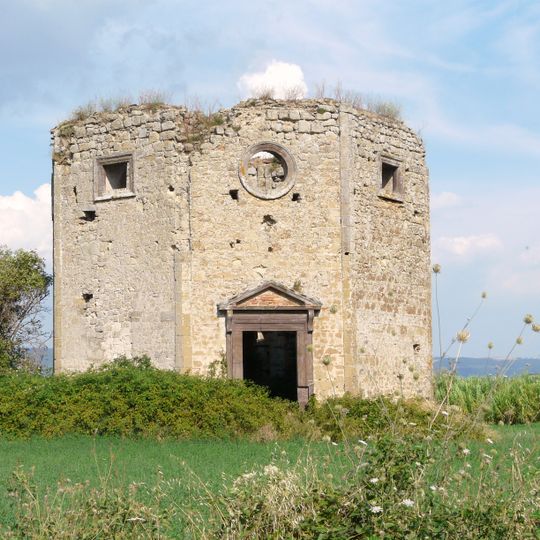
San Giovanni in Val di Lago is a roofless ruin of a Renaissance church standing in open countryside near the northern shore of Lake Bolsena, outside San Lorenzo Nuovo. Its main hall is an octagonal mass of rough light-grey and tan stone blocks, with a rectangular presbytery attached. The front wall holds a doorway under a wooden lintel and triangular pediment, a small window to the left, a circular opening above the door and another high window to the right.
The church was built between 1563 and 1590 to designs by Pietro Tartarino, who had worked under Alberto da Sangallo and also planned the cathedral of Montefiascone. Local tradition dates its origin to 5 June 1563, when Saint John the Baptist is said to have appeared to a boy named Nicola Pellegrini and asked that the earlier church on the site be rebuilt. The annual feast and sung Mass were moved to San Lorenzo Nuovo around 1800, and the neglected wooden roof structure was demolished in 1828.
Local tradition holds that on 5 June 1563 the Baptist appeared to a boy named Nicola Pellegrini and asked that the church dedicated to him there be rebuilt. The annual feast of Saint John and its sung Mass were moved around 1800 from the church to San Lorenzo Nuovo, after which the building was neglected. Painted traces remain in the lunettes inside the octagon: a blessing Christ and a dove of the Holy Spirit.
The ruins stand in open countryside near the northern shore of Lake Bolsena, in the Val di Lago locality, on the route of the old Via Francigena. The site is isolated and little frequented, so bring water and wear sturdy shoes for the rough ground. The walls have no roof and the top edge is uneven, so keep to open ground rather than climbing the stonework.
The octagonal plan follows models in nearby Montefiascone and Orvieto, and one by Antonio da Sangallo the Younger on Isola Bisentina. Pietro Tartarino's original design called for a brick dome, but a cheaper wooden roof of oak beams and tiles was built instead; it was demolished in 1828. Traces of wall paintings remain in the lunettes inside, including a blessing Christ and a dove of the Holy Spirit.
The community of curious travelers
AroundUs brings together thousands of curated places, local tips, and hidden gems, enriched daily by 95,038 contributors worldwide.