Porta alla Croce, Florence, Medieval city gate in Piazza Beccaria, Florence, Italy.
Porta alla Croce is a stone city gate at Piazza Beccaria connecting several major streets, featuring a central archway with ornate architectural elements and defensive design. The structure retains its original height and maintains the characteristic form of a fortified gateway.
Porta alla Croce formed part of Florence's late 13th-century walls, probably designed by Arnolfo di Cambio and dated to 1284. During the siege of 1529–1530 it was lowered to make it less vulnerable to cannon fire. Grand Duke Ferdinand III of Lorraine restored it in 1817–1818, and Giuseppe Poggi's urban plan of 1865–1871 demolished the walls and left the gate isolated in Piazza Beccaria.
The name comes from the cross al Gorgo, which stood nearer the Arno and marked, by tradition, where Saint Minias was beheaded before carrying his head to the hill of San Miniato al Monte. The gate was also called Porta Sant'Ambrogio, and just outside it official executions took place.
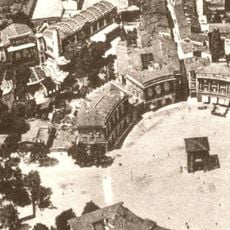
The gate stands isolated in the middle of Piazza Beccaria, a traffic island created by Giuseppe Poggi's 19th-century ring-road plan, so it is reached on foot via the surrounding crossings. A milestone inside marks 1,540 km from Piazza della Signoria, and a memorial records the water level of the 1966 Arno flood.
The 1310 plaque on the city side records the gate's dimensions, walls, moat and roads in Florentine braccia, beside the lily of Florence and the cross of the People. The original was moved to the Museo di San Marco storerooms after the 2018 restoration, which replaced it with a reproduction recreating the original polychromy.
The community of curious travelers
AroundUs brings together thousands of curated places, local tips, and hidden gems, enriched daily by 93,607 contributors worldwide.