Holy Name of Mary sanctuary, Baroque sanctuary in Lodrone, Italy
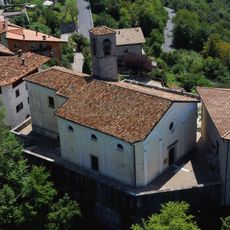
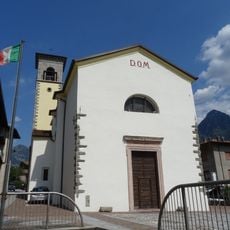
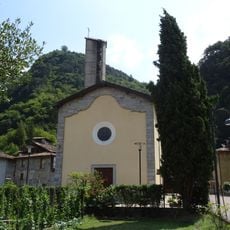
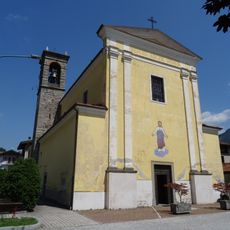
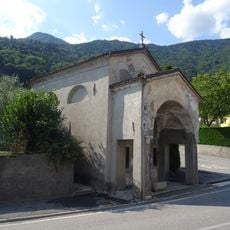
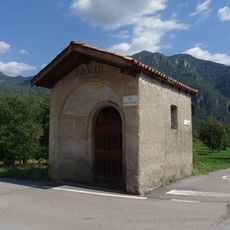
The Holy Name of Mary sanctuary stands at the southern edge of Lodrone, a hamlet of Storo, a few steps below the SS 237 road and near the Caffaro river. Its wide, low facade is divided into three bays by round arches, with a stucco relief of the Madonna dell'Aiuto over the portal and a double bell gable on the right. Inside, three short cross-vaulted nave bays end in a raised presbytery and two shallow side chapels with Baroque altars.
A first chapel may have been built in the 16th century, possibly at the wish of the Lodron counts, but the earliest documentary mention dates only from 1694. The church was rebuilt in Baroque forms between the late 17th and early 18th century, according to some sources for the marriage of Sebastiano Francesco Lodron and Anna Margherita Kuhen-Belasi, according to others through Girolamo Giuseppe Lodron, then curate of Lodrone, in 1725. Damaged by a flood in 1969, it was restored in 1974 and again in 1983, and in 1928 it was counted among the Marian sanctuaries of Trentino during a pastoral visit by Celestino Endrici.
The church is popularly called Madonna dell'Aiuto after its 16th-century votive painting, which was cut and stolen in 1866 and later found in Val Vestino. The Madonna was celebrated on 8 September until 1930, when parish priest Don Valentino Morelli moved the feast to 12 September, the Name of Mary, to separate it from the Ponte Caffaro market.
The sanctuary stands at the southern edge of Lodrone, on the SS 237 and a few steps below road level, near the Caffaro river that marks the border with the province of Brescia. The building faces north-west, so the facade is seen from the road; Palazzo Caffaro and the former church of Santa Croce are close by. It is a subsidiary church of the parish of the Annunciation of Mary in Lodrone.
The two Baroque side altars, contemporary with the 18th-century rebuilding, are attributed to the "Boscaì" workshop of Levrange and were restored in 2008. The church also keeps two canvases by Nicolò Dorigatti showing the finding of the True Cross, brought here from the former church of Santa Croce.
The community of curious travelers
AroundUs brings together thousands of curated places, local tips, and hidden gems, enriched daily by 94,670 contributors worldwide.