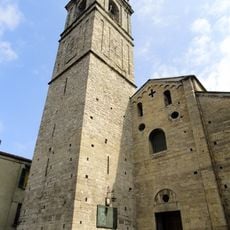
Bellagio's Castle, castle in Bellagio, Italy
Bellagio's Castle survives only as ruins within the park of Villa Serbelloni on the Bellagio promontory. A roughly twenty-metre wall southwest of the site is identified by archaeologists as Lombard, and the foundations of a large square-based tower are now incorporated into the building. Two Romanesque churches were built along the castle walls between 1080 and 1100: the larger, dedicated to Saint Peter, had a tall bell tower partly visible in the southern facade of Villa Serbelloni, while the smaller church stood in the castle keep at the top of the promontory.
Most historians hold that the Insubri built the castle, later enlarged by the Gauls or Lombards; a wall about twenty metres south-west of it and the foundations of a square tower are called Lombard by archaeologists. In 934 King Lothair granted the territory to his chamberlain Gherardus de Castelli, and in 1295 Littardo de' Castelli took refuge there after fleeing Milan. In 1375 Gian Galeazzo Visconti ordered the defences demolished, sparing the main church and a square tower.
The name Bellagio's Castle survives in the ruins inside the park of Villa Serbelloni, where a roughly twenty-metre wall southwest of the remains is attributed by archaeologists to the Lombards, and the foundations of a large square tower are now incorporated into a building. Two Romanesque churches were built along the walls between 1080 and 1100: the larger, dedicated to Saint Peter, had a tall bell tower partly visible in the southern facade of Villa Serbelloni, while the smaller church stood in the keep at the top of the promontory, its apse still legible.
The ruins lie inside the park of Villa Serbelloni, reached by a climb from Bellagio's centre; the villa itself is a private foundation and visits are by guided tour only, so check access before setting out. The remains are fragmentary, including a stretch of wall and a square tower base, so allow little time on site.
The castle's defensive value was doubted because the promontory is easy to overrun; it served mainly as a lookout and customs point. A roughly twenty-metre wall about twenty metres southwest of the ruins is attributed by archaeologists to the Lombards, and the footings of a large square tower are now enclosed within the later building.
The community of curious travelers
AroundUs brings together thousands of curated places, local tips, and hidden gems, enriched daily by 94,677 contributors worldwide.