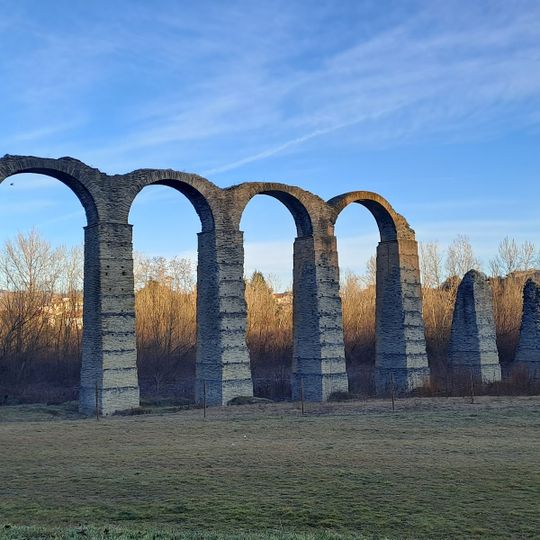
Acquedotto romano Acqui terme, Ruins of a Roman aqueduct in Acqui Terme, Italy
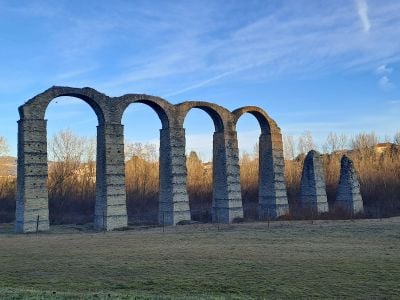
The Acquedotto romano di Acqui Terme is an ancient Roman water supply system in Acqui Terme, in northern Italy. The surviving sections consist of two rows of tapered stone pillars topped with rounded arches that once carried a water channel above the ground.
The aqueduct was likely built in the 1st century AD, possibly during the reign of Emperor Augustus, to supply the town then known as Aquae Statiellae. In the late 19th century, parts of the pillars were restored with bricks to secure the remaining arches.
The ancient name of the town, Aquae Statiellae, refers directly to its water, showing how central water management was to life here. The aqueduct once fed the town's famous Roman baths, making it the backbone of public life for generations.
The site is freely accessible at any time, with no entrance fee or set opening hours. The nearby Ponte Carlo Alberto bridge offers a good view of the arches from above, and walking or cycling paths along the ruins make it easy to explore from several angles.
Most visitors see only the visible arches, but most of the system ran underground: a pipe roughly 12 kilometers long followed the valley of the Erro stream before reaching the town. At the end, water was collected in a tank called the castellum aquae before being distributed to fountains and private homes.
The community of curious travelers
AroundUs brings together thousands of curated places, local tips, and hidden gems, enriched daily by 91,810 contributors worldwide.