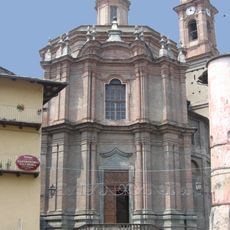
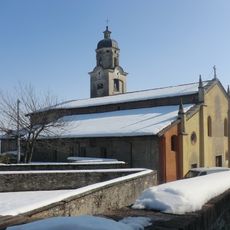
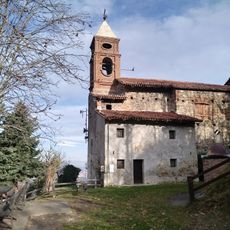
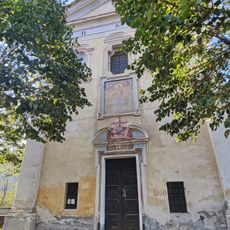
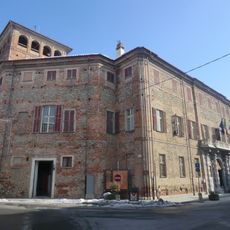
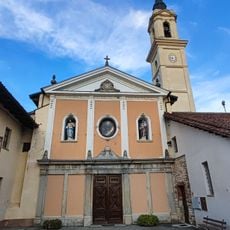
Eremo di Belmonte, Carthusian monastery and hermitage in Busca, Italy.
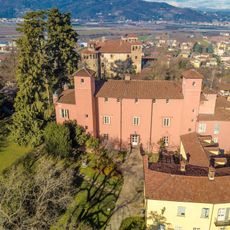
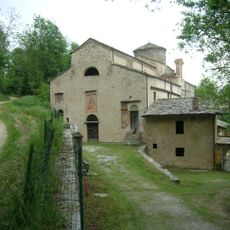
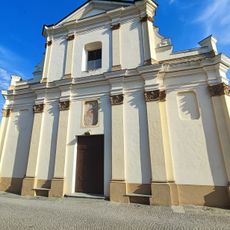
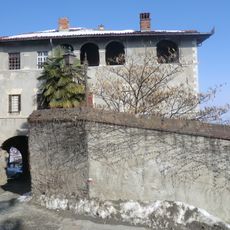
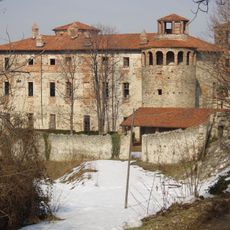
The Eremo di Belmonte is a former Carthusian monastery located in the hills of Busca at approximately 836 meters elevation, distinguished by a residential building arranged in a horseshoe pattern. A central courtyard is anchored by a garden featuring an Atlas cedar tree, giving the complex a distinctive horticultural character.
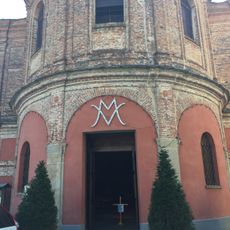
A 1277 act records a dependent community at Belmonte, a low house of the charterhouse of Buonluogo; the nuns left around the 1280s, though a prioress and five nuns are recorded in 1298. Before the mid-15th century it was attached to the Dominican nuns of Santa Maria delle Grazie near Castino. In the 17th century the Camaldolese took over and built the Baroque church with stuccoes by Domenico Beltramelli and paintings by Dallamano.
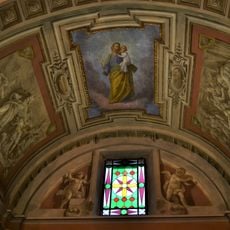
The vaults painted by Francesco Gonin carry allegories tied to the Italian Wars of Independence; Stanislao Grimaldi del Poggetto commissioned them for the building he had turned into a noble residence. The former hermitage is not normally open to visitors and admits the public only on occasions such as the FAI Spring Days.
The hermitage is reached by a small road of about 5 km from the historic centre of Busca, or on foot via trails linking Busca and Monte Pagliano. The complex is not normally open to visitors and is accessible only on specific occasions such as the FAI Spring Days.
The hilltop of this hermitage served as a location for scientific surveying work in the early 1800s under Baron Zach's direction. These geodetic measurements contributed to more precise mapping of the region, revealing how this isolated site held scientific importance beyond its religious function.
The community of curious travelers
AroundUs brings together thousands of curated places, local tips, and hidden gems, enriched daily by 94,652 contributors worldwide.