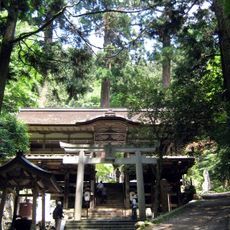
Kurama-dera, Buddhist temple in Northern Kyoto, Japan
Kurama-dera is a temple perched on Mount Kurama in the northern hills of Sakyō-ku, surrounded by old cedar groves and mountain air. Stone steps wind upward between wooden halls, shrines, and resting pavilions scattered across the slope.
The temple's founding is traced to the monk Gantei (Ganzen), youngest of the eight disciples who came from Tang China with Jianzhen; he built a hermitage and enshrined Bishamonten in 770. A later tradition credits Fujiwara no Iseito, who in 796 followed a white horse to the mountain and installed a Thousand-Armed Kannon beside the Bishamonten. The temple burned repeatedly, beginning with a fire in 1126, and was rebuilt each time. In 1949 abbot Kōun Shigaraki separated it from the Tendai sect and made it head temple of Kurama Kokyō.
The mountain's name, Mount Kurama, comes from the saddle (kura) of a white horse seen in a dream by the monk Ganzen, who founded the temple in 770. The temple's own teaching, Kurama Kokyo, was founded in 1947 by abbot Kouun Shigaraki, who had been a poet in the circle of Yosano Akiko; her study, the Winter Cypress Pavilion, was moved here from Tokyo. The Noh play Kurama Tengu is set on these slopes, where Ushiwakamaru is said to have trained.
Most visitors arrive in the morning and use the small cable car to shorten the climb, or walk the stone steps through the forest. Sturdy shoes help on uneven paths, especially when damp or after rain.
The founder is Ganzen, the youngest of eight disciples who came from Tang China with Jianzhen; a dream in 772 led him to Mount Kurama, where a falling tree crushed a demon and a Bishamonten statue appeared. The mountain path continues over the ridge to Kibune, and the temple runs its own cable car, the only railway operated by a religious corporation in Japan.
The community of curious travelers
AroundUs brings together thousands of curated places, local tips, and hidden gems, enriched daily by 92,796 contributors worldwide.