Jakkō-in, Buddhist nunnery in Ohara, Kyoto, Japan
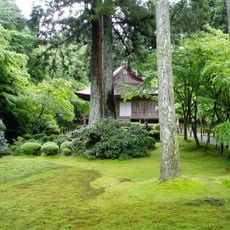
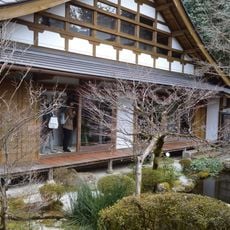
Jakkō-in is a Tendai nunnery in Ohara, Kyoto, with a single-story wooden main hall rebuilt in 2005 after an arson fire. The hall stands on a stone base under a broad hip-and-gable roof; round pillars support a deep veranda, and lattice panels flank a central doorway. A stone path leads to the entrance, and a pond called Migiwa no Ike lies on the grounds.
Founded by tradition in 594 by Prince Shōtoku for his father Emperor Yōmei, the temple was originally named Gyokusenji. In 1185, after the Taira defeat at Dannoura, Kenreimon-in Tokuko, daughter of Taira no Kiyomori, entered the temple under Awa no Naishi, took vows as Shinnyo Kakubiquni, and became its third chief priestess. The main hall, rebuilt in the Keichō era under Toyotomi Hideyori, burned down in an arson attack on 9 May 2000 and was reconstructed on 2 June 2005.
The main hall houses Buddhist statues and a modern Jizo sculpture created after a fire destroyed its predecessor in 2000. The space shows how religious objects carry spiritual meaning and connect people across generations.
Jakkō-in is about 15 minutes on foot from the Ohara bus stop, served by Kyoto Bus lines 10, 16, 17, 18, 19 and 95. The main hall, rebuilt in 2005, stands on a low stone base reached by dark wooden steps. The burnt original Jizō statue is kept in a storehouse on higher ground and shown only on set days.
The tomb of Kenreimon-in Tokuko, the Ohara Nishi Mausoleum, stands next to the temple grounds and is managed by the Imperial Household Agency; it was moved there from inside the precinct after the Meiji period. Near the temple are graves said to belong to her ladies-in-waiting, including Awa no Naishi, the model for the Ohara-me women who carry firewood to Kyoto.
The community of curious travelers
AroundUs brings together thousands of curated places, local tips, and hidden gems, enriched daily by 93,141 contributors worldwide.