Zōshigaya Cemetery, Public cemetery in Minami-Ikebukuro, Tokyo, Japan.
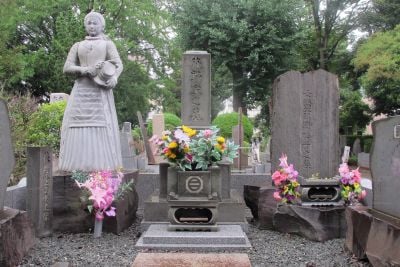
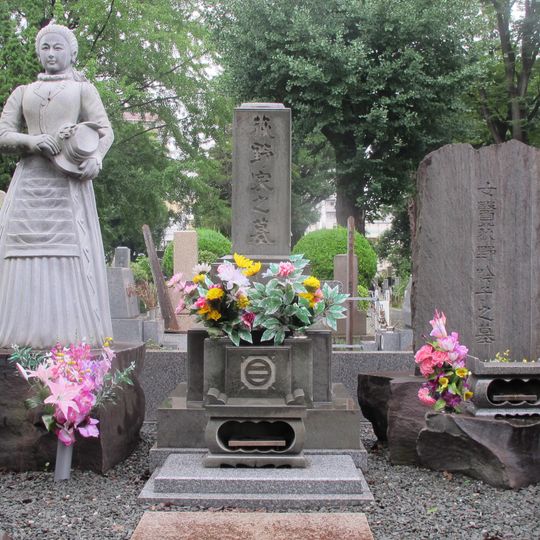
Zōshigaya Cemetery is a public burial ground in Minami-Ikebukuro, Toshima, Tokyo, covering 106,110 m². A paved road runs through the centre, lined with densely packed grey granite markers, from tall vertical slabs to low horizontal blocks and tiered bases, standing behind low concrete curbs that border narrow grass strips. White vertical posts at the front of graves bear black Japanese characters and numerals such as "1種5号2側" and "1種5号1側".
The cemetery was established in 1874 after the Japanese government prohibited burials in central Tokyo. This decision led authorities to create new burial grounds outside the urban core.
Graves of Natsume Sōseki, Nagai Kafū, Lafcadio Hearn, Izumi Kyōka, Satō Hachirō, Izumi Taku, Takehisa Yumeji, Oguri Kozukenosuke, Iwase Tadanari, John Manjirō, Edo-ya Nekohachi and Ōkawa Hashizō lie here. The Zōshigaya 1-chōme East Neighborhood Association notes that early-morning radio exercise groups meet on the grounds, and the Midori no Komichi no Kai tends the hedges and plants flowers.
The administration office provides maps showing notable graves and key areas to help visitors navigate the grounds. The site remains free to enter year-round and offers good walking conditions throughout the space.
Before becoming a cemetery, the land was the shogunate's hawk enclosure (御鷹部屋), where falcons for the shogun's hunting were kept; it had earlier been a medicinal herb garden under the third shogun Iemitsu in 1638. A large pine from the hawk-enclosure era still stands in the grounds.
The community of curious travelers
AroundUs brings together thousands of curated places, local tips, and hidden gems, enriched daily by 93,177 contributors worldwide.