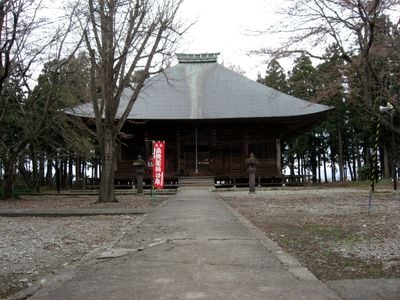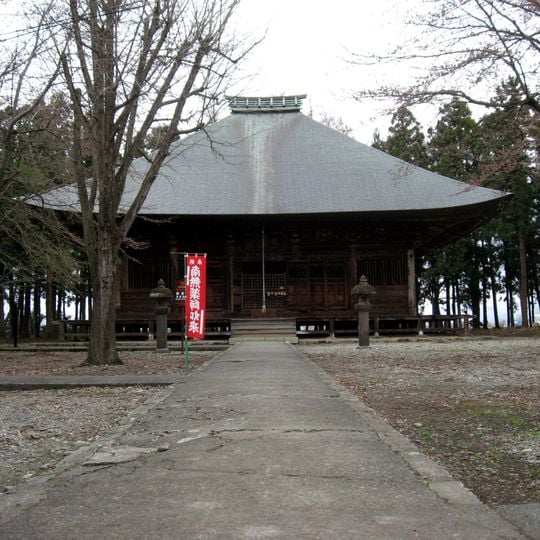
Shōjō-ji Temple, Buddhist temple in Yugawa, Japan.
Shōjō-ji is a Shingon-shu Buzan-ha temple in Yugawa, Fukushima Prefecture. Its Yakushi Hall, an early Muromachi-period building, stands on the site of the original lecture hall; its thatched roof was replaced with copper sheeting in 1964. The hall enshrines the National Treasure Yakushi Nyorai statue, while the flanking Nikko and Gakko Bosatsu are kept in the storage hall.
Tokuitsu, a Hossō scholar-monk, opened Shōjō-ji in 807. The sources give no direct document linking him to the foundation, but twelve early Heian statues, probably made at the temple's origin, support the connection. A fire in 1398 destroyed the earlier hall; the Yakushi Hall was rebuilt soon after by Tomita Sukemochi, a retainer of the Ashina clan. The temple later belonged to the Shingon sect and was a branch of Ninna-ji until early modern times.
The temple houses more than thirty Buddhist statues, including a Yakushi Nyorai figure carved from Zelkova wood, which visitors continue to revere today. These artworks show how believers used this place as a spiritual center across the centuries.
Shōjō-ji lies in the central part of the Aizu basin, at Katsujō-daibu 1764 in Yugawa village, about ten minutes by car from Oikawa Station on the JR Ban'etsu West Line. The Yakushi Hall stands at the site of the original lecture hall, with the storage hall holding the other statues nearby.
The main Yakushi Nyorai statue lacks the urna, the forehead dot typical of Buddha images. Carved from a single zelkova block split front-to-back, it was designated a National Treasure in 1996, the first Tōhoku Buddhist statue to receive that status.
The community of curious travelers
AroundUs brings together thousands of curated places, local tips, and hidden gems, enriched daily by 93,276 contributors worldwide.