Sugimoto-dera Temple, Buddhist temple in Nikaidō, Kamakura, Japan
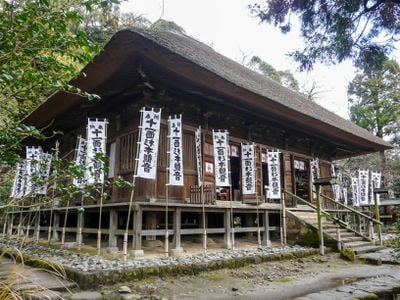
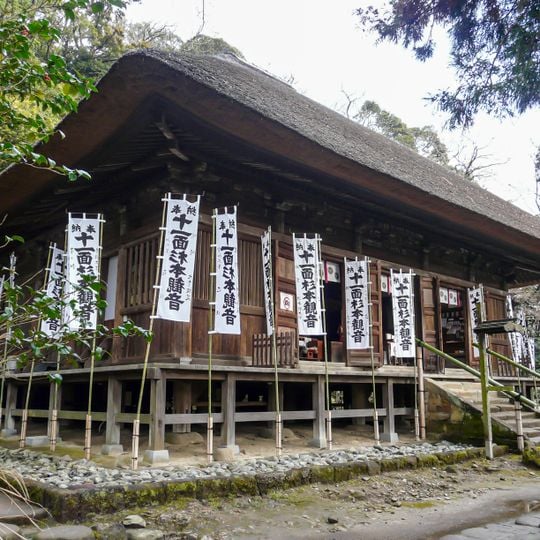
Sugimoto-dera is a Tendai Buddhist temple in Nikaidō, Kamakura, whose main hall stands on a raised wooden platform with a broad thatched roof and dark timber walls. Eleven white vertical banners bearing black characters hang in a row across the front, and a narrow wooden stairway with a railing rises on the right side.
Tradition credits the temple's founding to 734, when Empress Kōmyō ordered Gyōki and Fujiwara no Fusasaki to build a hall for an Eleven-Headed Kannon. In 1189 a fire destroyed the buildings; the bettō Jōdai-bō rescued the three statues and placed them under a large cryptomeria, giving the temple its name. Minamoto no Yoritomo visited in 1191 and funded repairs, and the temple became the first stop on the Bandō Sanjūsankasho circuit.
Sugimoto-dera is the first stop on the Bandō Sanjūsankasho, a 33-temple Kannon pilgrimage in eastern Japan. The circuit was created with support from Minamoto no Yoritomo and his son Sanetomo. The temple is also called Geba Kannon, or "Dismount Kannon", because riders would fall from their horses if they passed without showing respect.
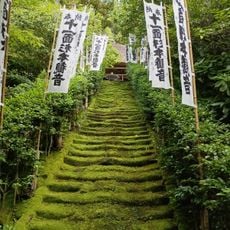
The worn Kamakura-stone steps between the gate and the main hall are closed; visitors use the newer stairway on the left. The temple is a one-minute walk from the Sugimoto Kannon bus stop, or about 30 minutes on foot from Kamakura Station. The three Kannon statues are shown only on the 1st and 18th of each month.
The name Sugimoto ("under the cryptomeria") comes from the 1189 fire: the bettō Jōdai-bō carried the three Kannon statues out of the flames and laid them beneath a large cedar. The rescue raised the temple's reputation among pilgrims. The three statues are normally hidden; they are shown on the 1st and 18th of each month.
The community of curious travelers
AroundUs brings together thousands of curated places, local tips, and hidden gems, enriched daily by 93,168 contributors worldwide.