Myōō-in Temple, Buddhist temple in Fukuyama, Japan
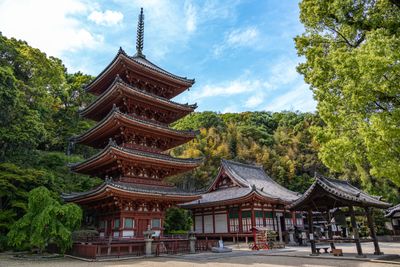
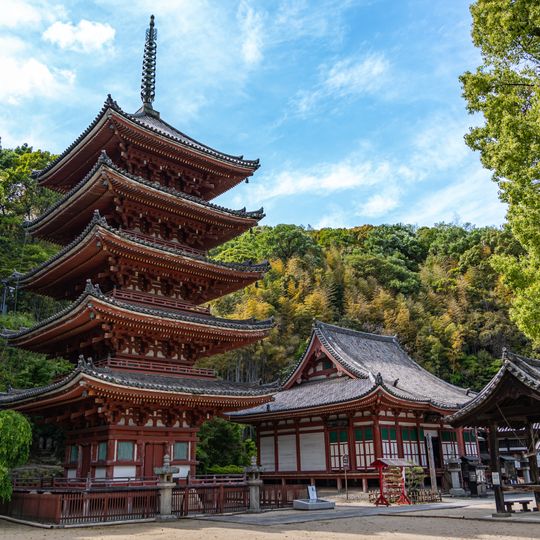
Myōō-in is a Shingon Buddhist temple at the foot of Mount Atago in Fukuyama. Its five-story pagoda, built in 1348, stands 29.14 m tall with dark grey tiled roofs curving upward at the corners and a metal spire on top; the main hall, rebuilt in 1321, sits nearby with a steep grey roof and red timber framing.
Founded in 807 by Kūkai as Jōfuku-ji, a Risshū temple, Myōō-in was rebuilt in 1321 under the patronage of Kiyo Sadatsune and the monk Raihō, and its five-story pagoda was completed in 1348. In the Edo period it merged with a nearby Myōō-in and came under the protection of the Mizuno clan, lords of Fukuyama, who restored its halls after a 1620 landslide.
The temple's name changed from Jōfuku-ji to Myōō-in when it merged with another temple under the Mizuno clan in the 1650s. The main image, a wooden Eleven-Faced Kannon attributed to Saichō, is kept in the main hall. The temple once had 48 branch temples and was a major center in the region.
The temple stands at the foot of Mount Atago beside the Ashida River, with the five-story pagoda on the left and the main hall to its right. The approach from the Kusadoenocho bus stop is on foot; the grounds are on a slope, so allow time for uneven paths.
The five-story pagoda dates to 1348 and displays pure Japanese architectural style with wall paintings inside. This structure is among the oldest surviving pagodas of its size in Japan, preserving medieval construction techniques and artistic methods.
The community of curious travelers
AroundUs brings together thousands of curated places, local tips, and hidden gems, enriched daily by 93,166 contributors worldwide.