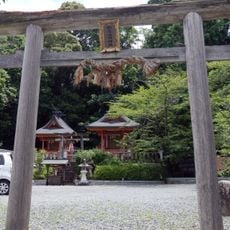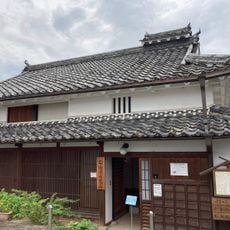
Jison-in Temple, Buddhist temple in Kudoyama, Japan.
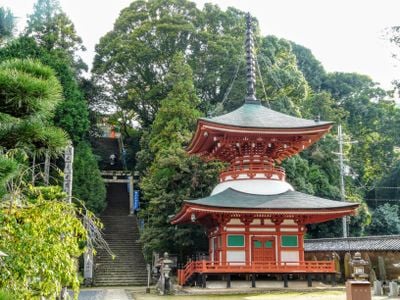
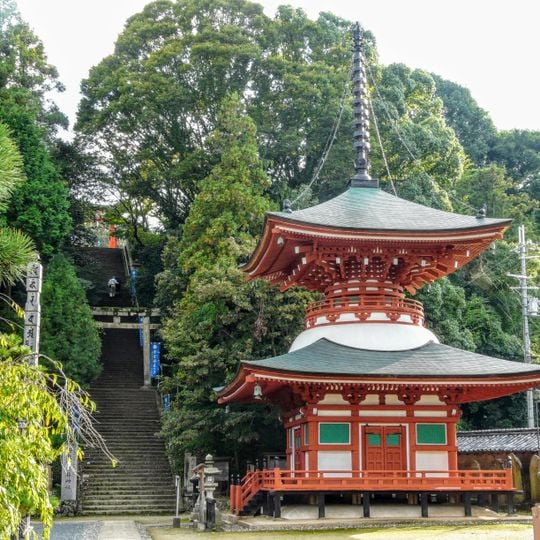
Jison-in is a Shingon temple at the foot of a wooded hillside in Kudoyama, at the start of the Koyasan Choishimichi pilgrimage route. Its two-tiered main hall, the Miroku-do, has a dark grey tiled lower roof with red brackets, a white facade with green panels and red doors, and above it a smaller cylindrical section banded red and white under a wide tiled roof, with a metal finial held by chains. The hall is a National Treasure-era rebuilding from the late Kamakura period, three bays square with a pyramidal cypress-bark roof.
In 816 Kūkai received the Kōyasan land from Emperor Saga and built Jison-in at the foot of Mount Amabuki in Kudoyama as the administrative office (Kōya mandokoro) and lodging for the mountain, with a hall, Jishiji, dedicated to Miroku. His mother, unable to enter the women-forbidden mountain, stayed here and died in 835; Kūkai then founded a memorial hall, and the name Jison-in derives from Jison, another name for Miroku. Floods of the Kinokawa in 1540 and 1544 destroyed most buildings, which were moved to the present Miroku-dan site.
Jison-in is known as "Nyonin Koya", the temple where women worshipped because they were barred from the summit. Kukai's mother, Tamayori Gozen, came from Sanuki and stayed here, devoted to the Miroku Buddha; after her death in 835 the temple took the name Jison from another name for Miroku. Votive tablets here are breast-shaped, with cloth breasts attached, offered by women praying for milk and safe childbirth.
Jison-in sits about 1.5 km, or 25 to 30 minutes on foot, from Kudoyama Station on the Nankai Koya Line. From the precinct, a stone stairway climbs past the 180th choishi stone marker toward Niukanshofu Jinja, so the temple works as the starting point of the Koyasan Choishimichi route. The grounds form part of the nationally designated historic site of that pilgrimage path.
The main hall's honzon, a wooden seated Miroku Buddha 91 cm tall, is a National Treasure dated by an 892 ink inscription on its robe and opened to view only once every 21 years, matching Kūkai's death day on the 21st. The temple's votive plaques carry cloth breasts, offered by women praying for milk and safe childbirth.
The community of curious travelers
AroundUs brings together thousands of curated places, local tips, and hidden gems, enriched daily by 93,168 contributors worldwide.