홍천 괘석리 사사자 삼층석탑, Three-storied stone pagoda in Hongcheon, South Korea
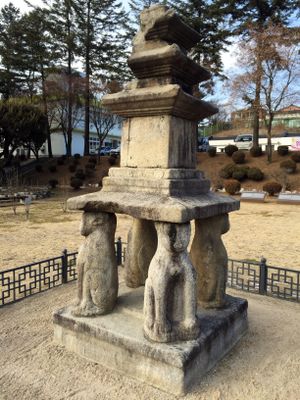
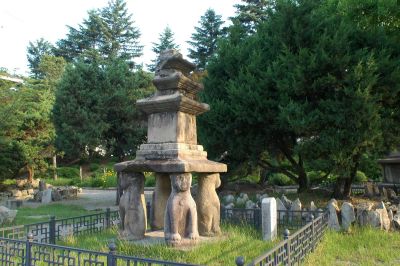
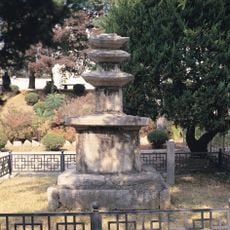
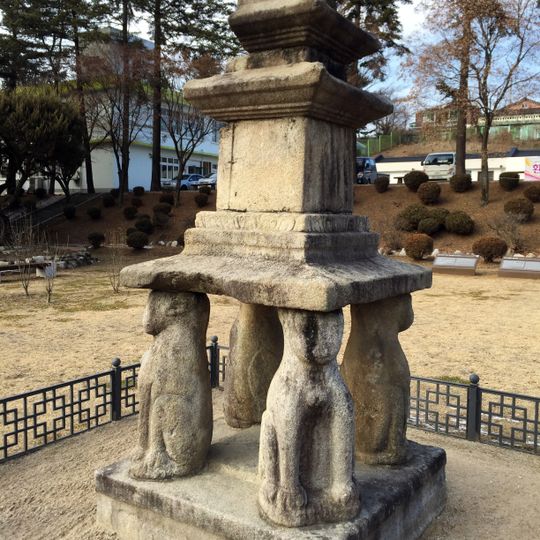
The Hongcheon Gwaeseokni Sasaja Samcheung Seoktap is a Goryeo-period stone pagoda now standing in the Hongcheon township office grounds, Gangwon Province. It has a two-tier base: the lower tier is carved with eye-shaped panels containing floral motifs, while the upper tier has a stone lion at each corner supporting a flat slab. Above rise three body-and-roof storeys, and only a square roof-support block remains at the top.
The pagoda was built during the Goryeo period, with stylistic features pointing to the mid-Goryeo era or later. It originally stood in Gwaeseok-ri, Duchon-myeon, where the surrounding area appears to have been a temple site, now turned into fields with only roof-tile fragments scattered around. It was moved to its current location inside the Hongcheon county office grounds and was designated Treasure No. 540 on 7 July 1971.
The name Sasaja, "four lions", comes from the four stone lions set one at each corner of the upper base, holding up the flat slab above them. Between them, lotus pedestals on the floor and ceiling of the enclosed space suggest a Buddha image once stood there. The lower base is carved with eye-shaped panels filled with flower motifs, a Goryeo-period feature.
The pagoda now stands within the grounds of the Hongcheon township office (eup office) in Hongcheon-eup, not at its original site in Gwaeseok-ri, Duchon-myeon, where only roof-tile fragments remain in what is now a field. It is an outdoor structure on a low platform ringed by a low metal fence with a geometric grid pattern, so it is viewed from outside the fence rather than entered.
Although the pagoda has three stories, there is no interior space inside it. It is a solid stone construction, and the four lions at the top originally surrounded a lotus pedestal that is thought to have once supported a Buddha figure.
The community of curious travelers
AroundUs brings together thousands of curated places, local tips, and hidden gems, enriched daily by 94,025 contributors worldwide.