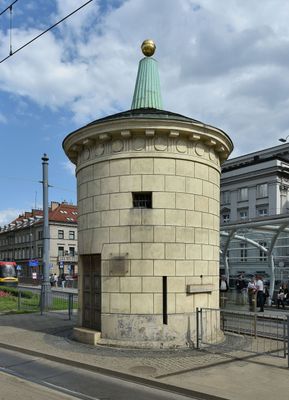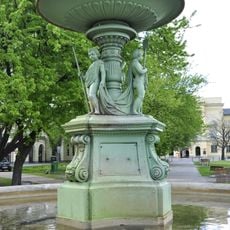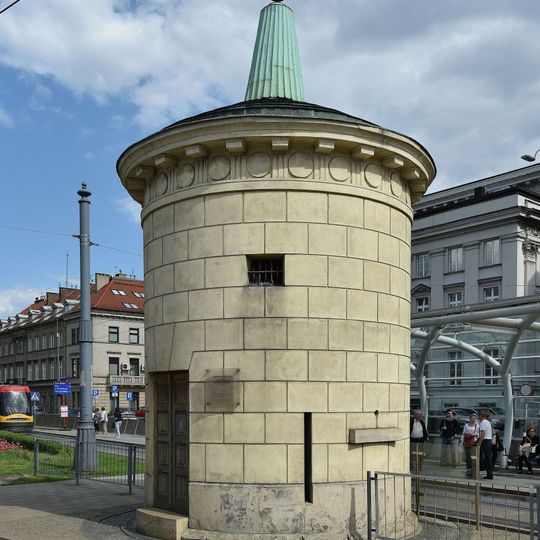
Fat Kaśka on Tłomackie, Neoclassical well in Warsaw, Poland.
Fat Kaśka on Tłomackie is a cylindrical well with rusticated stonework and a stepped roof crowned by a gilded ball. Located at the intersection of Solidarności Avenue, it displays the craftsmanship of neoclassical design with visible windows and reinforced foundations.
Architect Szymon Bogumił Zug designed this water well in 1787 at Tłomackem Square as a vital source for the neighborhood. It survived the Second World War and witnessed the destruction of the adjacent Great Synagogue in 1943.
The well acquired the name Fat Kaśka from local residents and reflects their connection to this everyday landmark that served the neighborhood. Its distinctive stepped roof and cylindrical form remain recognizable features in the urban landscape today.
The structure is easily accessible and visible from the street where it sits at a busy intersection. Following renovations in 2004, the stonework was restored and the foundation reinforced to return it to its original appearance.
The structure is one of the few surviving 18th-century wells in Warsaw and has been restored multiple times to maintain its form. Its persistence at a site with turbulent history makes it a rare witness to the city's past.
The community of curious travelers
AroundUs brings together thousands of curated places, local tips, and hidden gems, enriched daily by 91,967 contributors worldwide.