Jabłonowo Pomorskie Palace, Gothic Revival palace in Jabłonowo Pomorskie, Poland.
Jabłonowo Pomorskie Palace is a Gothic Revival residence designed by August Friedrich Stüler and supervised by Karol Lorenz, with turrets and a curtain wall that imitate a defensive castle. Its layout follows a calendar scheme: one tower for the year, 52 rooms for the weeks and 365 windows for the days. The interiors were styled in classicism with frescoes, chandeliers and stuccowork.
The palace was designed by August Friedrich Stüler, a pupil of Karl Schinkel, with construction supervised by Karol Lorenz. Stefan Narzymski, who had fought in the November Uprising, commissioned it after acquiring the estate through his wife Otolia Karwat in 1835. The couple died in 1867–1868 shortly after the residence was completed, and their daughter Marianna Ogińska inherited it. In 1933 the property was sold to the Sisters of the Providence Divine.
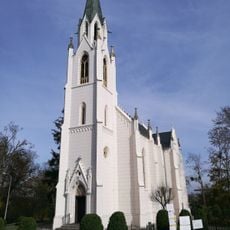
Since 1933 the palace has been the motherhouse of the Sisters of the Shepherdess of Divine Providence. The founder, Mother Maria Karłowska, is buried in the neo-Gothic chapel added by the order, designed by Teofil Zieliński.
The palace stands on a hill above the town, and the grounds are now the generalate of the Sisters of the Shepherdesses, so access to the buildings is limited. The neo-Gothic chapel, designed by Teofil Zieliński, holds the tomb of the order's founder, Mother Maria Karłowska.
Stone bridges scatter throughout the park, connecting different zones of the estate through carefully planned paths. These structures remain important features of the original English garden design and continue to shape how visitors move through the space.
The community of curious travelers
AroundUs brings together thousands of curated places, local tips, and hidden gems, enriched daily by 93,149 contributors worldwide.