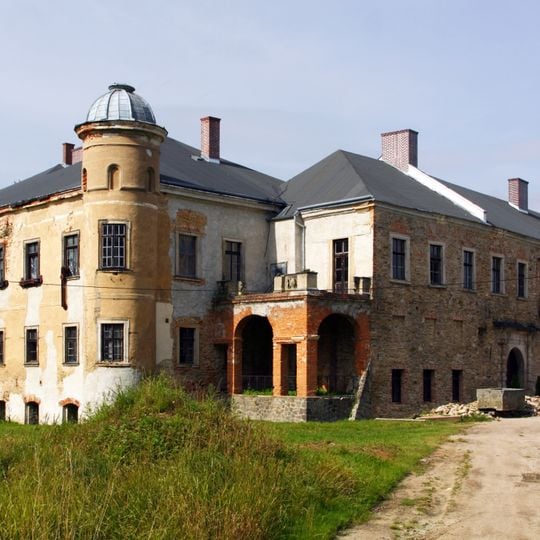
Palace in Luboradz, Renaissance palace in Luboradz, Poland
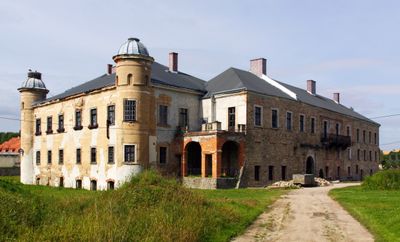
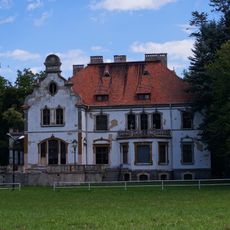
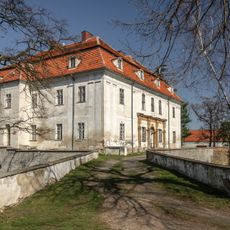
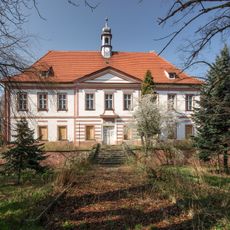
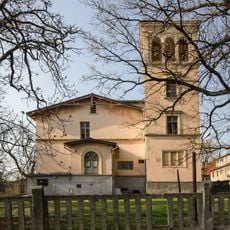
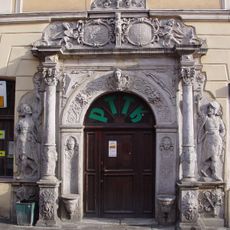
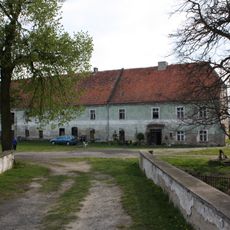
The Palace in Luboradz is a four-winged, two-storey building with a small inner courtyard, covered by gabled roofs. Above the courtyard entrance survives a cartouche with the coats of arms of Christoph Wazlaw von Nostitz and Marie Juliane von Tschetschau-Mettich. The east facade has a gate portal and a balcony over the former moat, while the west elevations retain remnants of Renaissance-Mannerist sgraffito decoration. Inside are a late-17th-century ballroom with portraits of the palace owners and polychrome Renaissance beamed ceilings in several rooms.
Luboradz was first mentioned around 1300. A defensive manor stood on the site; around 1560 it was rebuilt as a two-winged Renaissance residence, and the west and north wings survive in the present palace. Christoph Wenzel von Nostitz had it enlarged in 1681–1686 by the builder Antonio Domenico Rossi, adding a garden pavilion and a chapel. After 1742 it passed to Prussia; the Nostitz family held it until 1890.
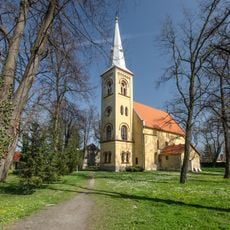
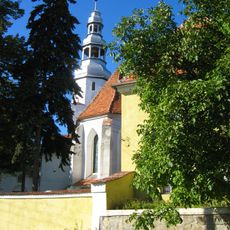
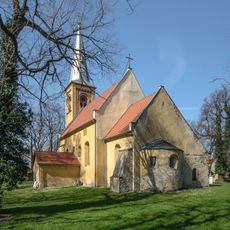
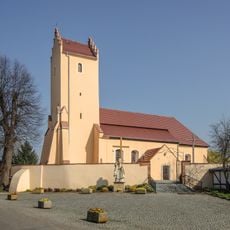
The palace chapel was added on the east side by Christoph Wenzel von Nostitz-Rokitnitz during the 1681–1686 rebuilding. The Silesian painter Michael Willmann created a cycle for the chapel; it is now held in the National Museum in Wrocław. The chapel's position next to the palace shows how worship was built into the residence.
The palace is registered as a protected monument, meaning access may be limited or require advance arrangements with local authorities. Visitors interested in exploring the site should inquire locally about current conditions and visiting possibilities.
The ballroom holds late-17th-century portraits of the palace's owners, and several rooms keep painted Renaissance beam ceilings. In the west wing's upper floor hangs an allegorical figure of Mars, moved there in 1938 from the library hall, whose 11,000 books were auctioned in Munich in 1895.
The community of curious travelers
AroundUs brings together thousands of curated places, local tips, and hidden gems, enriched daily by 94,391 contributors worldwide.