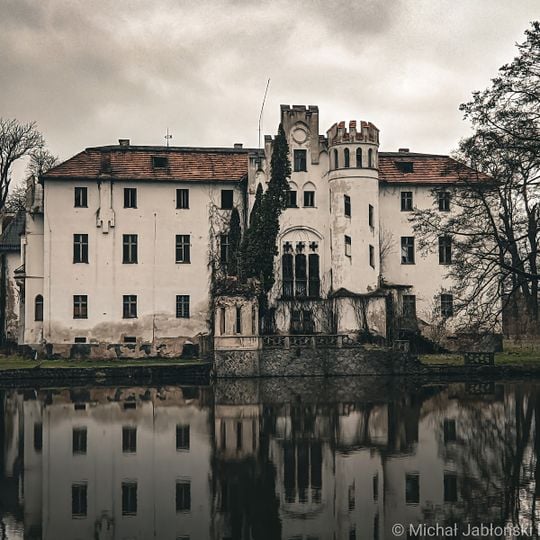
Palace in Dobrocin, Heritage palace in Dobrocin, Poland.
The Palace in Dobrocin is a neo-Gothic palace built on a horseshoe-shaped plan around an open courtyard facing north-west. Its two- and three-storey body is covered by hipped roofs with truncated tops, small dormers and gables; the seven-axis front has a three-axis pseudo-risalit with five pilasters and a stepped gable, and the main entrance passes through a pointed-arch portal. A neo-Gothic mullioned window in the south-west elevation holds the von Portatius coat of arms, and the pond-side tower has lost its conical roof.
A monastery estate, possibly a Templar commandery, once stood here; in 1484 Friedrich von Hochberg acquired it and founded the Güttmannsdorf line. The property passed to the Falkenhain and von Seherr-Thoss families and was baroquised in the 18th century. Kuno von Portatius, an imperial legation councillor, bought it in 1897 and had it rebuilt in neo-Gothic style in 1898–1899, with the south-west wing added in 1909.
The palace is known in Polish as Pałac w Dobrocinie and in German as Schloss Güttmannsdorf, the name used until 1945. The German name refers to the village's former name, Güttmannsdorf. After 1945 the building housed a shop, offices and a kindergarten, and part of its rooms served as flats.
The palace stands at the edge of the Dzierżoniów Valley, at the foot of the Gumińskie Hills, in the village of Dobrocin. It is privately owned and unused, so the interiors are not open; the building, the 19th-century park, the devastated palace chapel and the family cemetery can be seen from outside. The tower on the pond side has lost its conical roof.
In the neo-Gothic window with tracery on the south-west facade, facing the ponds, a cartouche bears the coat of arms of the von Portatius family, who bought the estate in 1897 and rebuilt it from 1898 to 1899. The tower on the pond side has lost its conical roof.
The community of curious travelers
AroundUs brings together thousands of curated places, local tips, and hidden gems, enriched daily by 94,527 contributors worldwide.


